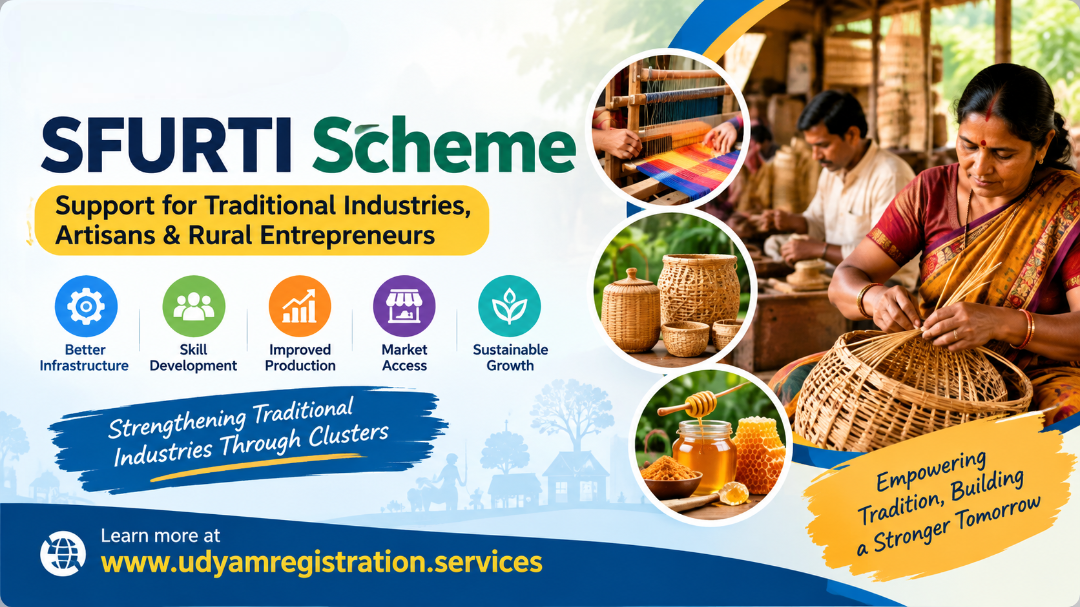
The SFURTI Scheme is a government initiative designed to support traditional industries, artisans, and rural entrepreneurs by helping them work together in organized clusters. The scheme focuses on improving production, product quality, skills, infrastructure, and market access so that traditional businesses can become more competitive and sustainable.
SFURTI stands for Scheme of Fund for Regeneration of Traditional Industries. It is implemented by the Ministry of Micro, Small and Medium Enterprises (MSME), Government of India. Through this initiative, traditional industries such as handicrafts, khadi, coir, bamboo, honey, textiles, and agro-processing receive support for cluster-based development.
The scheme is particularly relevant for artisans and traditional producers who face challenges such as limited access to modern machinery, inadequate infrastructure, high production costs, and difficulty reaching larger markets. Those interested in understanding related MSME services can also visit the Udyam Registration Portal to learn about enterprise registration and MSME recognition.
In this guide, you will learn about the SFURTI scheme, its objectives, eligibility requirements, financial assistance, application process, login facility, required documents, and the role of MSME-related registrations.
SFURTI Scheme: What Is It?
The SFURTI Scheme is a cluster development initiative that brings together traditional artisans and enterprises working in similar or related industries. Instead of providing support to each individual artisan separately, the scheme focuses on developing a group of producers within a cluster.
A cluster may include artisans, raw material suppliers, manufacturers, service providers, and other participants involved in a traditional industry.
For example, a group of bamboo artisans working in a particular region may need better tools, a shared production facility, training, and access to buyers. Through a cluster-based project, these common requirements can be addressed collectively.
The scheme supports the development of infrastructure, machinery, training facilities, product design, packaging, and marketing connections. Its objective is to improve the long-term sustainability of traditional industries while supporting employment and income opportunities for artisans.
SFURTI Scheme Ministry: Which Ministry Implements It?
The SFURTI Scheme Ministry is the Ministry of Micro, Small and Medium Enterprises (Ministry of MSME).
The Ministry is responsible for the overall administration and implementation framework of the scheme. Projects are developed and processed through designated agencies, including Implementing Agencies, Technical Agencies, and Nodal Agencies.
These organizations help identify suitable clusters, prepare project proposals, coordinate implementation, and support the development of traditional industries.
The official SFURTI website provides access to scheme guidelines, proposal registration, login facilities, and information about designated agencies.
Official website: SFURTI Official Portal
MSME SFURTI Scheme: Main Objectives
The MSME SFURTI Scheme aims to strengthen traditional industries through collective development and improved business infrastructure.
Its main objectives include:
- Organizing artisans and traditional producers into clusters.
- Improving productivity through modern tools and machinery.
- Providing training and skill development opportunities.
- Improving product quality, design, and packaging.
- Supporting access to raw materials and common production facilities.
- Developing marketing connections and access to buyers.
- Encouraging sustainable employment in traditional industries.
- Strengthening cluster management and long-term business sustainability.
These objectives help traditional industries adapt to changing market demands while preserving traditional skills and production methods.
SFURTI Scheme Benefits for Traditional Industries
The SFURTI Scheme benefits traditional industries by addressing common challenges that individual artisans may find difficult to solve independently.
Major benefits include:
Common Facility Centre (CFC): A shared facility where artisans can access machinery, equipment, and production infrastructure.
Raw Material Bank: Support for improving access to raw materials required for manufacturing and production.
Skill Development: Training programs that help artisans improve production techniques, product quality, and business skills.
Design and Product Development: Assistance for developing new products, improving designs, and adapting products to market requirements.
Marketing Support: Opportunities for buyer-seller meetings, market connections, exhibitions, and online marketing.
Improved Packaging: Support for making products more attractive and suitable for wider markets.
Exposure Visits: Opportunities for artisans to learn about new technologies, production practices, and market opportunities.
These activities are intended to help traditional producers improve their competitiveness and generate more sustainable income.
SFURTI Scheme Eligibility: Who Can Apply?
The SFURTI Scheme eligibility criteria depend on the type of project, the traditional industry, the proposed cluster, and the organization submitting the proposal.
The scheme is primarily designed for traditional industry clusters rather than individual entrepreneurs seeking a personal business loan or a standalone registration certificate.
Eligible types of organizations
Organizations that may be considered as Implementing Agencies include:
- Non-Governmental Organizations (NGOs).
- Central and State Government institutions.
- Semi-government institutions.
- Panchayati Raj Institutions (PRIs).
- Other eligible institutions with relevant experience in cluster development.
- Private-sector and corporate entities that meet the applicable requirements.
- Corporate and CSR foundations with suitable expertise.
Private-sector entities may participate through eligible project structures, including cluster-specific Special Purpose Vehicles (SPVs), subject to the applicable guidelines.
What makes a cluster suitable?
A proposed cluster may be assessed based on factors such as:
- Concentration of traditional artisans in a region.
- Common production activities or related products.
- Availability of traditional skills and raw materials.
- Potential for increasing production and employment.
- Scope for improving product quality and market access.
- Feasibility of establishing shared infrastructure.
Important: Meeting general eligibility conditions does not guarantee project approval. The proposal must satisfy the applicable scheme guidelines and approval requirements.
MSME SFURTI Guidelines: Project Categories and Funding
The MSME SFURTI guidelines describe the financial support available for eligible cluster development projects.
The Ministry's 2025 scheme booklet describes assistance of up to ₹2.5 crore for clusters with up to 500 artisans and up to ₹5 crore for clusters with more than 500 artisans. These are maximum assistance limits, not guaranteed payments to every cluster.
SFURTI financial assistance
|
Cluster category |
Number of artisans |
Maximum assistance described |
|
Regular Cluster |
Up to 500 |
Up to ₹2.5 crore |
|
Major Cluster |
More than 500 |
Up to ₹5 crore |
The final amount depends on the approved project, its components, applicable funding conditions, and the prevailing guidelines.
Types of project interventions
The scheme supports different types of interventions:
Soft Interventions: Activities such as training, capacity building, exposure visits, product development, and market promotion.
Hard Interventions: Physical infrastructure, machinery, equipment, common facilities, and other production-related investments.
Thematic Interventions: Activities that support the development and strengthening of a traditional industry cluster through coordinated interventions.
The exact funding ratios and contribution requirements may vary according to the applicable guidelines and project structure. Applicants should verify the latest rules before preparing a proposal.
SFURTI Scheme Industries: Which Sectors Are Covered?
The scheme focuses on traditional industries with potential for cluster-based development.
Some of the major sectors covered include:

Handicrafts
Traditional craft production, handmade decorative products, regional crafts, and artisan-based manufacturing.

Textiles and Khadi
Handloom weaving, traditional textile production, khadi-related activities, and other eligible traditional textile clusters.

Bamboo and Forest-Based Products
Bamboo crafts, traditional products made from natural materials, and related artisan activities.

Coir Industry
Traditional coir-based production, including eligible products made from coconut fiber.

Honey and Agro-Processing
Traditional honey production, processing activities, and eligible agricultural product clusters.
The scheme also covers other traditional industries, depending on the project's suitability and applicable guidelines.
SFURTI Project: How Does a Cluster Development Project Work?
A SFURTI project is a planned initiative to improve the productivity, infrastructure, skills, and market access of a traditional industry cluster.
A typical project may involve the following stages:
- Cluster identification: Identifying a traditional industry and the artisans or producers who will participate.
- Need assessment: Understanding common challenges related to machinery, skills, raw materials, and marketing.
- Project planning: Preparing a project proposal and identifying the infrastructure and development activities required.
- Agency coordination: Working with the relevant Implementing Agency, Technical Agency, and Nodal Agency.
- Project appraisal: Reviewing the proposal for feasibility, eligibility, financial requirements, and expected outcomes.
- Approval and implementation: Carrying out the approved activities according to the applicable guidelines.
- Monitoring and sustainability: Reviewing project progress and supporting the long-term operation of the cluster.
The actual project structure and approval process depend on the scheme's applicable guidelines and the designated agencies.
SFURTI Scheme Apply Online: How to Submit a Proposal
The SFURTI Scheme apply online process is intended for eligible organizations and agencies seeking support for cluster development projects.
An individual artisan generally cannot apply independently for a personal grant through the scheme in the same way that a person might apply for an individual business loan.
Step-by-step application process
Step 1: Visit the official portal
Open the SFURTI official website to access the available scheme information, guidelines, and application facilities.
Step 2: Review the guidelines
Read the applicable SFURTI guidelines to understand the eligibility criteria, project requirements, financial assistance, and agency responsibilities.
Step 3: Register on the portal
Eligible organizations can use the proposal registration or sign-up facility, where available, to create the required account.
Step 4: Log in and prepare the proposal
Use the portal's login facility to access the relevant proposal process. Enter the organization and cluster details and prepare the project information.
Step 5: Upload supporting documents
Submit the documents required for the organization, cluster, project plan, financial details, and other applicable requirements.
Step 6: Submit the proposal
Submit the proposal through the prescribed process for review by the relevant agency.
Step 7: Follow the review and approval process
The proposal may undergo appraisal, clarification, and approval procedures before the project can proceed.
The exact application workflow may change, so applicants should follow the instructions currently displayed on the official portal.
SFURTI Login: How to Access the Online Portal
The SFURTI login facility is used by registered users to access the scheme's online functions.
The portal provides a login option along with a facility to sign up for a new proposal. Access to specific functions depends on the user's registration and role.
How to log in
- Visit the official SFURTI website.
- Select the login option.
- Enter the credentials associated with your registered account.
- Complete any additional verification required by the portal.
- Access the relevant proposal or account section.
If you have not registered, check whether the new proposal sign-up option is available for your organization.
Official portal: SFURTI Scheme Login and Registration
Do not share your password or OTP with unauthorized individuals.
SFURTI Scheme Documents Required for Application
The documents required for a SFURTI project depend on the applicant organization, cluster structure, and nature of the proposed activities.
Applicants may need to prepare the following documents, subject to the applicable guidelines:
|
Document or information |
Purpose |
|
Organization registration documents |
Establishes the legal identity of the applicant |
|
PAN and other applicable identification |
Supports organizational verification |
|
Details of the Implementing Agency |
Identifies the organization responsible for implementation |
|
Cluster profile |
Describes artisans, traditional activities, and geographical coverage |
|
Detailed Project Report (DPR) |
Explains the project plan, costs, and expected outcomes |
|
Financial details |
Supports assessment of project funding and contributions |
|
Land or infrastructure details |
Relevant where facilities or infrastructure are proposed |
|
Artisan and beneficiary information |
Describes the people expected to benefit |
|
Implementation plan |
Explains how project activities will be carried out |
|
Supporting declarations and approvals |
Required where specified by the scheme |
This is a general preparation checklist, not a complete official document list. Applicants should consult the latest guidelines and portal instructions before submitting a proposal.
Udyam Registration and MSME Certificate: Is It Required for SFURTI?
Udyam Registration and the SFURTI Scheme serve different purposes.
Udyam Registration is a process through which eligible enterprises obtain recognition as Micro, Small, or Medium Enterprises under the applicable MSME classification.
SFURTI is a cluster development scheme focused on traditional industries and artisan groups.
An MSME certificate may be relevant for an enterprise or organization where required by the applicable project conditions. However, Udyam Registration alone does not automatically make an individual eligible for SFURTI financial assistance.
Before applying, organizations should check whether the specific project requires MSME-related documentation, organizational registration, or other approvals.
For general MSME information, the Udyam Registration Portal provides details about enterprise registration.
Udyog Aadhaar and SFURTI Scheme: What Is the Connection?
Udyog Aadhaar was an earlier registration system for micro, small, and medium enterprises. It was replaced by the Udyam Registration system.
Businesses that previously held a Udyog Aadhaar Memorandum may need to check the applicable migration or registration requirements.
For a SFURTI project, the relevance of Udyog Aadhaar or Udyam-related records depends on the organization and the specific documentation required.
An old Udyog Aadhaar number should not be treated as automatic approval for a SFURTI project.
SFURTI Scheme vs. Other MSME Schemes
The Ministry of MSME operates different schemes to address the needs of enterprises, artisans, and traditional industries.
|
Scheme |
Main purpose |
|
SFURTI |
Cluster-based development of traditional industries |
|
CGTMSE |
Credit guarantee support for eligible loans to micro and small enterprises |
|
PMEGP |
Support for eligible new micro-enterprises and employment generation |
|
MSME Cluster Development Programme |
Development of common infrastructure and cluster facilities |
Each scheme has its own eligibility criteria, funding structure, and application process. Applicants should identify the scheme that matches their project requirements.
SFURTI Scheme Status: How to Check Project Progress
The SFURTI portal provides information about approved clusters and project-related activities.
To check available information:
- Visit the official SFURTI portal.
- Look for the dashboard, cluster information, or project-related sections.
- Search for the relevant cluster or project details.
- Review the information available about approval, implementation, or functional status.
The Ministry's dashboard also provides information about approved clusters and project progress.
SFURTI Scheme: Important Things to Know Before Applying
Before preparing a project proposal, keep these points in mind:
- SFURTI is a cluster-based development scheme, not a personal loan scheme.
- Individual artisans may benefit through an approved cluster.
- Financial assistance depends on the approved project and applicable guidelines.
- The scheme's maximum funding limits do not mean every project receives the maximum amount.
- A business's MSME registration does not automatically guarantee eligibility.
- Organizations should work with the relevant agencies and follow the official application process.
- Applicants should verify the latest guidelines because scheme rules and administrative procedures can change.
For the latest information, refer to the official SFURTI portal .
Frequently Asked Questions (FAQs)
1. What is the SFURTI Scheme?
The SFURTI Scheme stands for Scheme of Fund for Regeneration of Traditional Industries. It supports traditional industries and artisans through cluster development, infrastructure, training, and market access.
2. Who is eligible for the SFURTI Scheme?
Eligible organizations such as NGOs, government institutions, and other qualifying agencies can submit cluster development proposals. Individual artisans may benefit through approved clusters.
3. What is the maximum financial assistance under the SFURTI Scheme?
The Ministry's 2025 scheme booklet describes assistance of up to ₹2.5 crore for clusters with up to 500 artisans and up to ₹5 crore for clusters with more than 500 artisans. The actual amount depends on the approved project and applicable guidelines.
4. How can I apply for the SFURTI Scheme online?
Eligible organizations can visit the official SFURTI portal, review the guidelines, register for a proposal, and submit the required project details and documents through the prescribed process.
5. Is SFURTI available for individual business owners?
The scheme primarily supports traditional industry clusters. Individual business owners and artisans may participate as cluster beneficiaries, subject to project requirements.
6. What is the full form of SFURTI?
SFURTI stands for Scheme of Fund for Regeneration of Traditional Industries.
7. Which ministry manages the SFURTI Scheme?
The Ministry of Micro, Small and Medium Enterprises (Ministry of MSME), Government of India, administers the scheme.
8. What industries are covered under SFURTI?
Traditional sectors such as handicrafts, textiles, khadi, bamboo, coir, honey, and agro-processing are among the industries supported under the scheme.
9. Is Udyam Registration compulsory for SFURTI?
Udyam Registration is not a universal substitute for the scheme's eligibility requirements. Whether it is required depends on the applicant's role and the applicable project guidelines.
10. How can I access the SFURTI login portal?
Visit the official SFURTI website at https://sfurti.msme.gov.in/ and select the login option to access the relevant account facilities.
11. What is a Common Facility Centre under SFURTI?
A Common Facility Centre is a shared facility that provides eligible cluster members with access to infrastructure, machinery, equipment, or other production-related resources.
12. Does the SFURTI Scheme provide a business loan?
SFURTI is a cluster development scheme that provides project-based assistance under its guidelines. It is not a conventional individual business loan.
13. What is the role of a Technical Agency in SFURTI?
A Technical Agency supports project development and implementation, including technical planning, cluster development, and market-related activities, according to its assigned responsibilities.
14. How can I check the SFURTI project status?
You can visit the official SFURTI portal and review the available dashboard or cluster information to find details about approved projects and their progress.
15. Is the SFURTI Scheme still relevant for traditional artisans?
Yes. The Ministry of MSME's 2026 announcement reported that 513 clusters had been approved under the scheme since 2015–16, with approximately 3.03 lakh traditional artisans expected to benefit. The status of new proposals should be verified through the official portal.
Conclusion
The SFURTI Scheme is designed to strengthen traditional industries by organizing artisans into clusters and supporting shared infrastructure, training, product development, and marketing opportunities.
For eligible organizations, understanding the scheme's guidelines, project requirements, financial assistance limits, and application process is essential before preparing a proposal.
Artisans and traditional producers can explore whether an existing or proposed cluster in their industry provides opportunities to participate in these development activities.