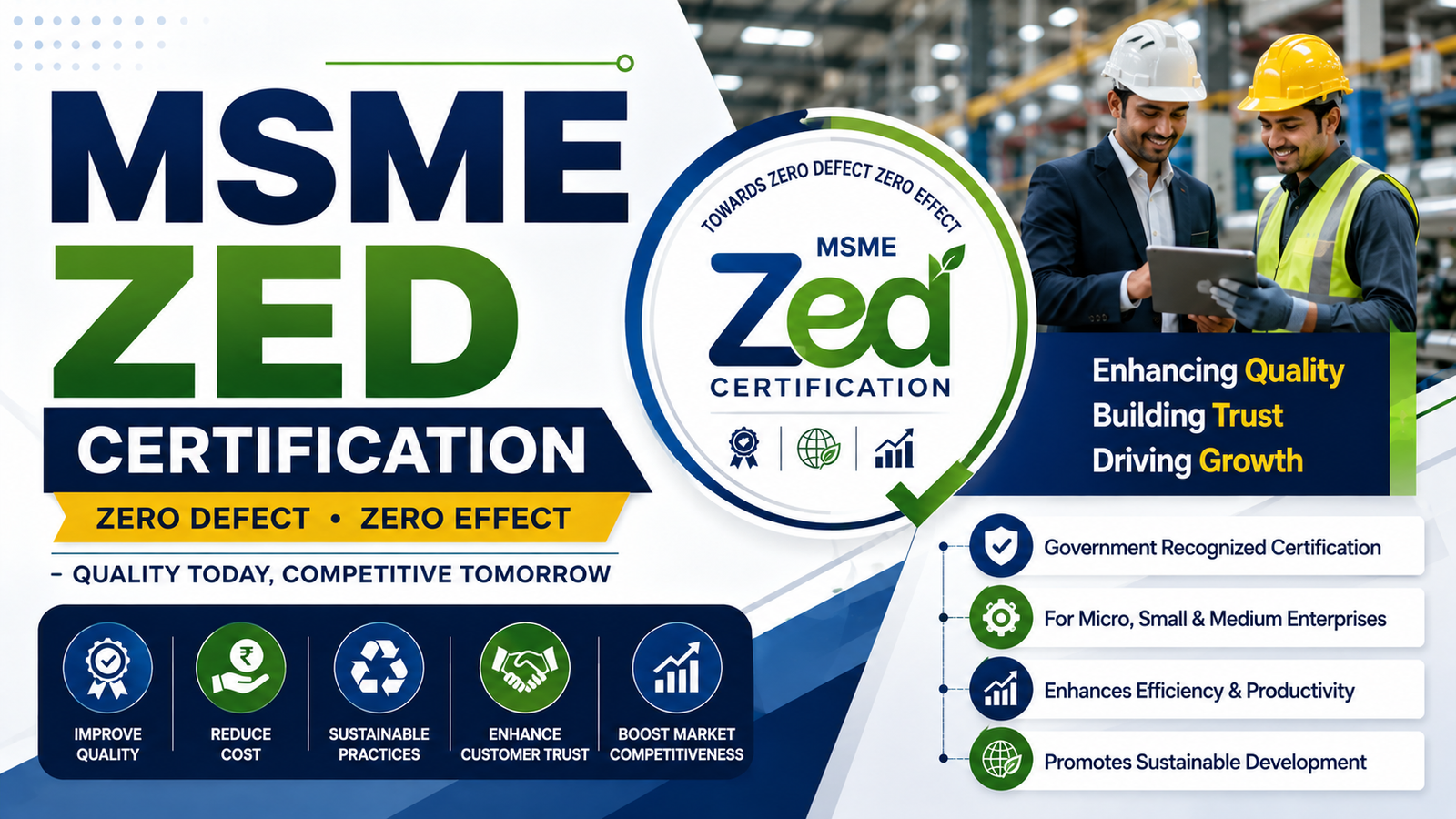
MSME ZED Certification is a government-backed initiative designed to encourage Micro, Small and Medium Enterprises to manufacture products with Zero Defect and Zero Effect. The scheme focuses on improving product quality, productivity, environmental performance, resource efficiency and the overall competitiveness of MSMEs.
For businesses that are planning to obtain government recognition, completing Udyam Registration Portal formalities is important because MSMEs registered through the official Udyam system are eligible to participate in the MSME Sustainable (ZED) Certification Scheme, subject to the applicable requirements. The Ministry of Micro, Small & Medium Enterprises states that all MSMEs registered with the Udyam registration portal can participate in the ZED programme and avail applicable benefits and incentives.
The ZED initiative is part of the broader MSME Champions Scheme, which brings together initiatives related to sustainable manufacturing, competitiveness and innovation. The Ministry describes ZED as a programme intended to encourage MSMEs to adopt quality-focused and environmentally responsible manufacturing practices.
In this guide, we will explain MSME ZED, ZED registration, ZED certificate, ZED certification levels, eligibility, subsidy, benefits, the ZED portal and the application process.
What Is MSME ZED Certification?
MSME ZED Certification stands for MSME Sustainable (Zero Defect Zero Effect) Certification.
The idea behind ZED is based on two principles:
- Zero Defect: Manufacturing quality products with minimum defects, wastage and rejections.
- Zero Effect: Reducing the negative impact of manufacturing activities on the environment.
The objective is not simply to provide an MSME certificate. It is intended to encourage enterprises to improve their manufacturing systems and continuously upgrade their processes.
According to the Ministry of MSME, the scheme aims to encourage MSMEs to manufacture quality products using modern technology and improve processes to achieve high quality and productivity with minimal environmental impact. It also aims to develop an ecosystem for ZED manufacturing and improve MSME competitiveness and export potential.
What Does ZED Mean for MSMEs?
ZED can be understood as a framework for improving the way an enterprise operates.
A ZED-oriented MSME may focus on:
- Product quality
- Process efficiency
- Reduction of manufacturing defects
- Reduction of wastage
- Energy conservation
- Environmental performance
- Resource efficiency
- Standardisation
- Productivity improvement
- Technology adoption
- Continuous improvement
This can help businesses become more competitive in domestic as well as international markets.
The Ministry's 2025-26 Annual Report highlights potential benefits including reduced wastage, increased productivity, improved operational efficiency, environmental awareness, energy conservation, better resource utilisation and expanded market opportunities.
What Is the MSME Sustainable ZED Certification Scheme?
The MSME Sustainable ZED Certification Scheme is a component of the MSME Champions framework.
The scheme was launched in April 2022 and focuses on promoting Zero Defect Zero Effect practices among MSMEs.
Its major objectives include:
- Promoting quality manufacturing.
- Reducing defects and wastage.
- Encouraging environmentally responsible production.
- Improving productivity.
- Supporting technology adoption.
- Improving competitiveness.
- Encouraging standardisation.
- Supporting continuous improvement.
- Helping MSMEs move towards higher ZED levels.
- Supporting national and global market competitiveness.
Who Can Apply for MSME ZED Certification?
The official Ministry guidelines state that all MSMEs registered with the Udyam Registration Portal of the Ministry of MSME are eligible to participate, subject to the scheme's applicable requirements.
Therefore, an entrepreneur should generally ensure that the enterprise has valid Udyam Registration before starting the ZED journey.
Businesses should also verify the latest scheme guidelines and portal requirements before submitting an application because government programmes can be updated periodically.
What Is ZED MSME Registration?
ZED MSME registration refers to registering an eligible MSME on the ZED platform to participate in the certification programme.
The process is online.
The government MyMSME portal currently includes ZED among its MSME services, while the Ministry's scheme page directs eligible MSMEs to the ZED online portal for application.
Entrepreneurs should use official government portals rather than third-party websites claiming to provide an official ZED registration.
How to Apply for MSME ZED Certification?
The general application journey can be understood through the following steps.
Step 1: Obtain Udyam Registration
The enterprise should have valid Udyam Registration because eligibility for the ZED scheme is linked to Udyam registration.
Step 2: Access the Official ZED Portal
Visit the official ZED portal referred to by the Ministry of MSME.
The Ministry's official scheme page provides the ZED portal as:
Step 3: Register/Login
Use the available registration or login facility and provide the required enterprise information.
Step 4: Complete the ZED Pledge
The ZED programme includes a pledge/commitment stage through which an enterprise begins its ZED journey.
Step 5: Select the Certification Level
The enterprise can proceed through the applicable ZED certification journey.
Step 6: Assessment and Improvement
The enterprise may need to undertake assessment and address identified areas for improvement.
Step 7: Certification
After meeting the relevant requirements, the enterprise can receive the applicable ZED certification.
The exact process, assessment requirements, fees and documentation should be checked on the current official portal before applying.
MSME ZED Certification Levels
The programme uses three principal certification levels:
1. ZED Bronze
Bronze is the entry-level certification.
It provides an initial recognition of an MSME's efforts towards adopting ZED practices.
2. ZED Silver
Silver represents a higher level of implementation and maturity.
An enterprise moving from Bronze towards Silver is expected to improve its quality and sustainable manufacturing practices.
3. ZED Gold
Gold is the highest of the three main ZED certification levels.
It represents a more advanced level of adoption of ZED practices.
The Ministry's scheme information identifies the three levels as Bronze, Silver and Gold.
ZED Certificate for MSME
A ZED certificate for MSME is evidence that an eligible enterprise has achieved the applicable ZED certification level under the government programme.
Depending on the level achieved, the enterprise may receive:
- Bronze certification
- Silver certification
- Gold certification
The certificate should not be confused with Udyam Registration. They serve different purposes.
Udyam Registration identifies an eligible enterprise as an MSME, whereas ZED Certification recognises the enterprise's adoption and achievement within the ZED quality and sustainability framework.
ZED Certification Cost
The cost structure can change according to the latest scheme guidelines and applicable updates.
The Ministry's current scheme webpage lists certification costs of:
| ZED Level | Listed Certification Cost |
|---|---|
| Bronze | ₹10,000 |
| Silver | ₹40,000 |
| Gold | ₹90,000 |
However, the scheme also provides government financial support that can substantially reduce the effective cost for eligible MSMEs.
The Ministry's 2025-26 Annual Report records a different certification-cost structure in its reporting, which demonstrates why applicants should verify the current amount on the official ZED portal before making any payment.
MSME ZED Subsidy
One of the most important reasons businesses search for MSME ZED subsidy is the financial assistance available under the programme.
The Ministry's current scheme page lists a ₹10,000 joining reward, with Bronze effectively becoming free if the reward is availed, along with certification-cost subsidies of:
- 80% for Bronze
- 60% for Silver
- 50% for Gold
Additional subsidy provisions may also apply to eligible categories.
The 2025-26 Annual Report further records enhanced support arrangements, including 100% subsidy for women-owned MSMEs and additional subsidy provisions for certain categories.
Because subsidy rules and amounts can be revised, businesses should verify the applicable benefit at the time of application.
Additional MSME ZED Subsidy
The scheme provides additional subsidy in specified situations.
According to the Ministry's current scheme information, an additional 10% may be available for:
- Women-owned MSMEs
- SC/ST-owned MSMEs
- MSMEs in the North Eastern Region
- Himalayan regions
- Left Wing Extremism-affected areas
- Island territories
- Aspirational districts
An additional 5% may be available for MSMEs that are part of:
- SFURTI
- Micro & Small Enterprises Cluster Development Programme (MSE-CDP)
These benefits are subject to the applicable scheme conditions.
Financial Assistance for Testing and Certification
ZED is not limited to the certification fee.
The scheme also provides financial assistance for testing, quality certification and product certification.
The Ministry currently states that eligible assistance can cover up to 75% of the total cost, subject to a maximum subsidy of ₹50,000.
This support can be useful for MSMEs that need testing or certification to improve their product quality and market acceptance.
Handholding and Consultancy Support
An MSME may need professional assistance to identify gaps and improve its processes.
The ZED programme provides financial assistance of up to ₹2 lakh for handholding and consultancy aimed at helping an MSME achieve the next certification level.
This can be useful for enterprises that have achieved one level but want to progress to a higher ZED rating.
Technology Upgradation Support
Environmental improvement can sometimes require investment in cleaner technologies or pollution-control solutions.
The ZED scheme provides support of up to ₹3 lakh for moving towards zero-effect solutions, pollution-control measures and cleaner technologies, subject to the applicable guidelines.
This makes ZED relevant not only from a quality perspective but also from a sustainability perspective.
What Are the Benefits of ZED Certification?
There are several potential benefits of obtaining ZED certification.
1. Better Product Quality
ZED encourages enterprises to focus on reducing defects and improving consistency.
2. Reduction in Wastage
Better process control can help reduce raw-material wastage, rejection and rework.
3. Improved Productivity
Efficient production processes can improve output and operational efficiency.
4. Environmental Responsibility
The Zero Effect component encourages enterprises to reduce their environmental impact.
5. Energy Conservation
Improved processes and technologies can support more efficient energy use.
6. Better Market Opportunities
A stronger focus on quality and sustainability can improve an enterprise's competitiveness.
7. Technology Upgradation
Eligible MSMEs can explore financial support for certain technology-related improvements.
8. Recognition
ZED certification provides recognition of an enterprise's progress towards quality and sustainable manufacturing.
9. Access to Additional Incentives
Certain states and financial institutions may provide additional incentives to ZED-certified MSMEs.
The Ministry's 2025-26 Annual Report states that 22 States/UTs had included ZED in their industrial policies and that 19 financial institutions had initiated or notified incentives such as concessions in processing fees and interest rates for ZED-certified MSMEs.
What Is an MSME ZED Rated Enterprise?
An MSME ZED rated enterprise is an MSME that has undergone the applicable ZED assessment/certification journey and achieved a recognised level.
The three major levels are:
Bronze → Silver → Gold
Businesses can use the ZED framework to identify areas requiring improvement and progressively work towards higher certification levels.
MSME ZED vs Udyam Registration
Many entrepreneurs confuse these two registrations.
| Udyam Registration | ZED Certification |
| Provides MSME recognition | Recognises ZED practices |
| Based on MSME eligibility | Based on ZED certification requirements |
| Important for accessing eligible MSME schemes | Focuses on quality and sustainability |
| Obtained through the Udyam portal | Applied through the ZED system |
| Does not itself certify product quality | Encourages quality and sustainable manufacturing |
For an entrepreneur, these can therefore complement each other rather than replace one another.
Is ZED Certification Mandatory?
ZED certification is generally a voluntary quality and sustainability initiative, not a universal mandatory certification for every MSME.
It is intended to encourage enterprises to voluntarily improve their manufacturing systems and achieve higher levels of quality and sustainability.
However, individual buyers, tenders, industry requirements or other programmes may have their own conditions. Businesses should therefore check the requirements applicable to their particular activity.
How Can ZED Help a Small Business?
Suppose a manufacturing MSME frequently faces product rejection.
The business can use ZED principles to examine:
- Why defects are occurring
- Where production wastage is happening
- Whether machines require upgrading
- Whether workers need additional training
- Whether quality-control procedures are adequate
- Whether energy is being used efficiently
- Whether environmental practices can be improved
The objective is to move from simply identifying problems to creating systems that prevent recurring problems.
What Is the ZED MSME Login?
ZED MSME login refers to accessing the enterprise's account through the official ZED portal.
Entrepreneurs searching for ZED MSME login, MSME ZED login, ZED MSME government login or similar terms should be careful about unofficial websites.
The official Ministry scheme page directs applicants to the ZED portal at zed.msme.gov.in.
Always check that you are using the official government portal before entering business information, login credentials or payment details.
What Is the Official ZED MSME Website?
The Ministry of MSME identifies the official ZED portal as:
zed.msme.gov.in
The MyMSME portal also lists ZED among its available MSME services.
Entrepreneurs should avoid websites that imitate government portals or claim to provide ZED registration without clearly being authorised.
The official Ministry website is also available at msme.gov.in, where the ZED scheme is listed under technology upgradation and quality certification.
Frequently Asked Questions
1. What is MSME ZED Certification?
MSME ZED Certification is a government initiative promoting Zero Defect Zero Effect practices among MSMEs to improve quality, productivity, sustainability and competitiveness.
2. What does ZED stand for?
ZED stands for Zero Defect Zero Effect.
3. Who is eligible for ZED Certification?
MSMEs registered through the Udyam Registration Portal are eligible to participate in the ZED programme, subject to applicable scheme requirements.
4. What are the ZED certification levels?
The three main levels are Bronze, Silver and Gold.
5. Is ZED certification mandatory?
No, ZED is generally a voluntary initiative intended to encourage MSMEs to improve quality and sustainability.
6. What is ZED MSME subsidy?
The scheme provides financial support towards certification costs and additional assistance for eligible testing, consultancy and cleaner-technology measures. The exact subsidy depends on the applicable guidelines and enterprise category.
7. How much subsidy is available for ZED certification?
The Ministry's current scheme page lists certification-cost subsidies of 80% for Bronze, 60% for Silver and 50% for Gold, along with a ₹10,000 joining reward and additional subsidy provisions for specified categories.
8. What is a ZED certificate for MSME?
It is recognition awarded to an eligible MSME after completing the applicable ZED certification process and achieving the relevant level.
9. What is ZED MSME registration?
It refers to registering an eligible enterprise on the official ZED platform to participate in the ZED certification programme.
10. What is ZED MSME login?
It is the login facility used by registered enterprises to access their ZED account and related services on the official portal.
11. Can a Udyam-registered MSME apply for ZED?
Yes. The Ministry states that MSMEs registered through the Udyam registration portal are eligible to participate in the ZED certification scheme, subject to applicable conditions.
12. Does ZED certification provide business benefits?
It can support quality improvement, productivity, resource efficiency, sustainability and competitiveness. Certain states and financial institutions may also provide additional incentives.
13. Can ZED help with environmental improvement?
Yes. The Zero Effect component encourages cleaner production, pollution-control measures, resource efficiency and environmental responsibility.
14. Is financial assistance available for testing?
Yes. The current Ministry scheme information provides assistance of up to 75% of eligible testing/quality/product certification costs, subject to a maximum subsidy of ₹50,000.
15. Where can I check the latest ZED information?
For the latest eligibility, registration procedure, subsidy and certification information, check the official Ministry of MSME website and the official ZED portal.
Conclusion
MSME ZED Certification is an important government initiative for enterprises that want to improve quality, productivity and environmental performance. The Zero Defect Zero Effect approach encourages MSMEs to reduce defects and wastage while adopting more sustainable and efficient production practices.
The programme offers three major certification levels—Bronze, Silver and Gold—along with financial assistance for eligible certification, testing, consultancy and cleaner-technology activities.
For businesses operating under the MSME framework, Udyam Registration is an important prerequisite for participating in the ZED programme. Once eligible, an enterprise can explore the official ZED portal and understand the certification requirements applicable to its business.
Because subsidy amounts, certification costs and programme guidelines can be updated, entrepreneurs should always verify the latest information through official government sources before applying or making payments.