Forgot Udyam Registration Details? Get Help Today
Running a micro, small, or medium enterprise in India becomes easier when your business is registered under the Udyam Registration port...
Read Full GuideAlready registered under Udyog Aadhaar (UAM) or old EM-Part II? Migrate to the new Udyam portal to keep your MSME benefits active. 100% free, paperless, online process — takes just 15 minutes end-to-end.
Re-register or update your Udyam details online. Non-compliance leads to deactivation of all MSME subsidies, CGTMSE loan eligibility, Section 43B(h) payment protection, GeM seller status, and legal protections.
Registered before 1 July 2020 on udyogaadhaar.gov.in — UAM certificates are no longer valid, migrate to Udyam.
Legacy MSME registrants under the pre-UAM Entrepreneurs Memorandum system — must re-register on Udyam.
Business has grown or shifted MSME category — update to reflect new 2026 classification limits.
MSME certificate deactivated due to missed deadlines — re-register to reactivate and restore benefits.
New address, ownership, bank account, PAN, or GSTIN — all require a refreshed Udyam certificate.
This form is for enterprises already registered under UAM / Udyog Aadhaar / old MSME system. New businesses should use the New Udyam Registration form instead.
Udyam Re-Registration and Duplicate Certificate
Running a micro, small, or medium enterprise in India becomes easier when your business is registered under the Udyam Registration port...
Read Full Guideभारत में छोटे और मध्यम व्यवसायों (MSME) के लिए Udyam Registration एक बेहद महत्वपूर्ण प्रक्रिया है। यदि आपने पहले से रजिस्ट्रेशन कर लिया...
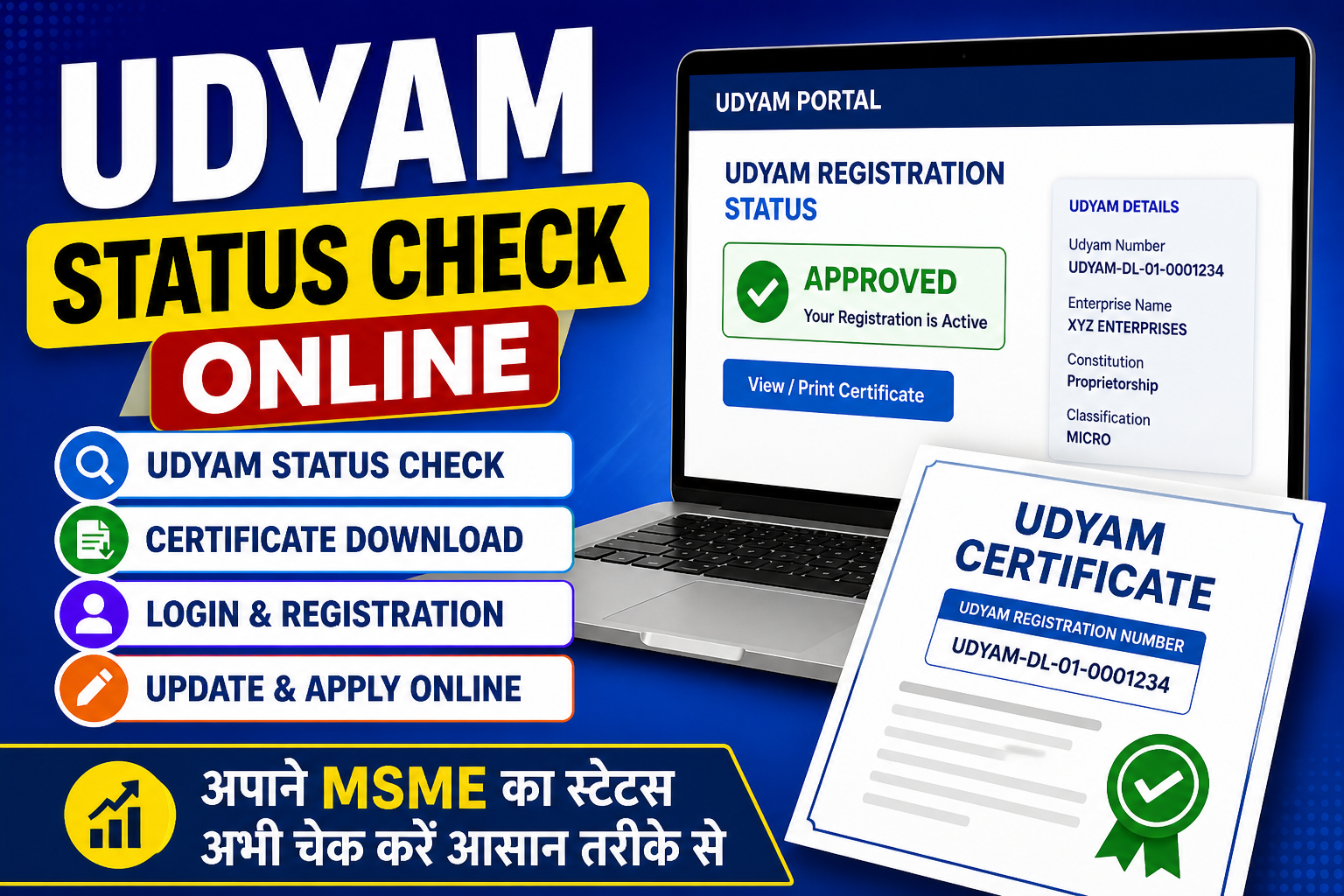
Read Full GuideMSME Subsidy Schemes 2026: Complete List, Eligibility & Benefits Introduction to MSME Subsidy Schemes in India 2026 MSME su...
Read Full GuideProfit and Loss Account Format: Complete Guide for Business Owners Introduction: Why Every Business Needs a Proper Profit and Loss...
Read Full GuideEntrepreneurship in India 2026: Complete Guide to Starting Your Business Introduction: Why 2026 is the Golden Era for Entrepreneur...
Read Full GuideDGFT Portal: Complete Guide to Foreign Trade Registration & Services Introduction to DGFT Portal and Its Importance for Indian...
Read Full GuideBalance Sheet Format in India: Complete Guide with Templates 2026 Introduction to Balance Sheet Format in Indian Accounting Pro...
Read Full GuideBest Web Hosting Services in India 2026: Complete Guide & Reviews Introduction: Why Choose Ind...
Read Full GuideLabour Laws in India 2026: Complete Guide for Employers & Employees Introduction to Labour Law...
Read Full GuideNOC Certificate in India: Types, Application Process & Complete Guide What is NOC Certificate ...
Read Full GuideHow to Download TDS Certificate Online: Complete Guide 2026 Introduction to TDS Certificates in In...
Read Full GuideHDFC Business Loan: Eligibility, Interest Rates & Application Guide Introduction: Why HDFC Bus...
Read Full GuideHow to Get Legal Heir Certificate in India: Complete Guide 2026 Introduction: Why Legal Heir Certi...
Read Full GuideGST Return Filing: Complete Step-by-Step Guide for 2026 Introduction: Why Accurate GST Return Fili...
Read Full GuideBusiness Loan Interest Rates in India 2026: Complete Comparison Guide Introduction: Why Business L...
Read Full GuideESI Card Kaise Banwayen: Employee State Insurance Complete Guide 2026 ESI Card ka Introduction: Ky...
Read Full GuideHow to File GST Returns Online: Complete Step-by-Step Guide 2026 Introduction: Why Timely GST Fili...
Read Full GuideHow to Start an Online Business in India: Complete 2026 Guide Introduction: Why 2026 is the Perfec...
Read Full GuideGeM Portal Registration: Complete Guide for Government Procurement Introduction to GeM Portal and ...
Read Full GuideUAN Number Complete Guide: How to Check, Activate & Use 2026 Introduction: Why Every EPF Membe...
Read Full GuideSBI Business Loan: Eligibility, Interest Rates & Apply Online Introduction: Why SBI Business L...
Read Full GuidePower of Attorney in India: Complete Guide to Types, Registration & Usage Introduction: Why Po...
Read Full GuideHow to Get Import Export Code (IEC) in India: Complete Guide 2026 Introduction to Import Export Co...
Read Full GuideHow to Check Income Tax Refund Status Online: Complete Guide 2026 Introduction: Why Income Tax Ref...
Read Full GuideRent Agreement Format & Registration: Complete Legal Guide 2026 Introduction: Why Proper Rent ...
Read Full GuideJan Dhan Yojana Account Opening: Benefits, Documents & Process 2026 Jan Dhan Yojana का परिचय: ...
Read Full GuideTop 50 Profitable Business Ideas in India 2026: Complete Guide Why 2026 is the Best Time to Start ...
Read Full GuideHow to Create Google Business Listing: Complete Setup Guide 2026 Introduction: Why Google Business...
Read Full GuideDigital India Initiative: Complete Guide to Schemes, Benefits & Online Services Digital India ...
Read Full GuideDomain Registration in India: Complete Guide to Register Your Website Domain Introduction: Why Dom...
Read Full GuideAtmanirbhar Bharat: Complete Guide to Self-Reliant India Initiative Introduction: Atmanirbhar Bhar...
Read Full GuideHow to Access EPF Passbook Online: Complete Guide 2026 Introduction: Why EPF Passbook is Essential...
Read Full GuideHow to Apply for Bank Loan Online in India: Complete Guide 2026 Introduction: Why Online Bank Loan...
Read Full GuideE Shram Registration Online: Complete Step-by-Step Guide 2026 What is E Shram Registration and Why...
Read Full GuideDigital Marketing in India 2026: Complete Guide for Businesses Introduction to Digital Marketing f...
Read Full GuideIncome Tax Calculator 2026: How to Calculate Tax Online for Free Introduction: Why Accurate Income...
Read Full GuideHow to Check PAN Card Status Online: Complete Guide 2026 Introduction: Why Checking Your PAN Card ...
Read Full GuidePM Mudra Yojana 2026: Loan Categories, Eligibility & How to Apply PM Mudra Yojana: India's Fla...
Read Full GuideHow to Apply for MUDRA Loan Online: Complete Guide 2026 Introduction to MUDRA Loan Online Applicat...
Read Full GuidePF Withdrawal Rules 2026: Complete Process & Online Application Guide Introduction: Why Unders...
Read Full GuideHow to File ITR Online in India: Step-by-Step Guide 2026 Introduction: Why Online ITR Filing is Es...
Read Full GuideIncome Tax Slab Rates 2026: Complete Guide with New Tax Structure Income Tax Slabs 2026: What Ever...
Read Full GuideWhat is Form 16: Complete Guide to TDS Certificate for Employees Introduction: Why Form 16 is Crit...
Read Full GuidePF Registration for Employees: Complete Guide to EPF Account Setup Introduction: Why PF Registrati...
Read Full GuidePradhan Mantri Yojana 2026: Complete List & Benefits Guide Introduction: Why Pradhan Mantri Yo...
Read Full GuideHow to Create a Website: Complete Step-by-Step Guide 2026 Why Every Business Needs a Website in 20...
Read Full GuideHow to Set Up Google My Business: Complete Guide for Indian Businesses Introduction: Why Google My...
Read Full GuideUdyam Re-Registration is the official process of migrating an existing MSME certificate from the older Udyog Aadhaar Memorandum (UAM), EM-Part II, or any pre-2020 MSME scheme to India's unified Udyam portal (udyamregistration.gov.in), launched on 1 July 2020 by the Ministry of Micro, Small & Medium Enterprises.
The Udyam portal replaced all legacy MSME registration systems as the single, authoritative online platform for MSME identity and benefits. Every UAM / Udyog Aadhaar holder registered before 1 July 2020 was required to re-register (migrate) to Udyam — and the compliance cycle continues in 2026 with an updated deadline to keep your MSME status active.
Udyam Re-Registration online is 100% free, paperless, and takes just 15 minutes. You get a new 19-digit Udyam Registration Number (URN), a QR-coded e-certificate, and auto-linked GST/ITR verification — replacing your legacy 12-digit UAM number permanently.
All existing UAM / EM-II / MSME holders must re-register (migrate) to Udyam by 21 April 2026. Non-compliance results in automatic suspension of MSME status and loss of all associated benefits, including CGTMSE loans, subsidies, Section 43B(h) protection, GeM eligibility, and tender exemptions.
Understanding the difference between your old UAM and the new Udyam system is the foundation of a successful re-registration. Here is a side-by-side comparison:
| Feature | Old UAM / Udyog Aadhaar | New Udyam (post 1 July 2020) |
|---|---|---|
| Portal | udyogaadhaar.gov.in (discontinued) | udyamregistration.gov.in (official) |
| Registration Number | 12-digit UAM (e.g., DL01A1234567) | 19-digit URN (e.g., UDYAM-DL-01-1234567) |
| Certificate Format | PDF without QR code | QR-coded, digitally signed e-certificate |
| Verification | Self-declaration only | Auto-verified via PAN, GST, and ITR databases |
| Aadhaar OTP | Optional | Mandatory for registration and update |
| Validity | Expired — obsolete since 1 July 2020 | Lifetime valid (with periodic updates) |
| Multi-activity Coverage | Only one activity per UAM | Multiple NIC codes under one URN |
| Benefits Eligibility | Suspended without migration | Full access to all MSME schemes in 2026 |
| Legal Standing | Not accepted by banks / GeM / tenders | Mandatory proof for all MSME benefits |
| Re-Registration Required? | YES — All UAM / EM-II holders must migrate to Udyam | |
Udyam Re-Registration is mandatory for the following categories of existing MSME holders in 2026:
The Union Budget 2024 announced revised MSME thresholds effective 1 April 2025, which continue to apply in 2026. If your enterprise now falls in a different category under these enhanced limits, you must declare the correct figures during Udyam Re-Registration:
| Category | Investment (Plant & Machinery) | Annual Turnover | Revision from 2020 |
|---|---|---|---|
| Micro | ≤ ₹2.5 Crore | ≤ ₹10 Crore | ↑ Up from ₹1 Cr / ₹5 Cr |
| Small | ≤ ₹25 Crore | ≤ ₹100 Crore | ↑ Up from ₹10 Cr / ₹50 Cr |
| Medium | ≤ ₹125 Crore | ≤ ₹500 Crore | ↑ Up from ₹50 Cr / ₹250 Cr |
Both criteria (investment and turnover) must be satisfied simultaneously. If either threshold is exceeded, the enterprise is reclassified upward to the next category. Re-register with your latest financial figures.
The 2026 limits are far more generous than the old UAM thresholds. Millions of enterprises previously classified as "Small" or "Medium" may now qualify as "Micro" — unlocking additional subsidies, lower interest rates, and fewer compliance burdens. Declare correctly during re-registration to maximise benefits.
The complete online Udyam Re-Registration process takes approximately 15 minutes. Here is the exact step-by-step walkthrough:
On successful verification, your new Udyam Certificate with fresh URN is generated immediately. Download it from the portal or check your registered email. Your old UAM is automatically flagged as migrated — no separate cancellation needed.
Udyam Re-Registration follows a largely paperless, self-declaration process. Keep the following ready before starting:
The Udyam portal auto-verifies turnover and investment figures via ITR and GST returns. Discrepancies between declared and actual filed data may cause immediate rejection or later suspension. Ensure all your ITR and GST filings are up to date before starting Udyam Re-Registration.
Migrating your UAM / EM-II to Udyam unlocks or restores the following benefits in 2026:
A typical micro enterprise that completes Udyam Re-Registration saves ₹2–5 lakh annually through interest subsidies, subsidies, tender exemptions, and faster buyer payments under Section 43B(h) alone.
The Udyam Re-Registration portal supports migration for all the following business entity types — select the correct one during the online form:
Choosing the correct option on the Udyam portal is critical. Using the wrong one can cause duplicate entries, rejection, or loss of benefits. Here is the decision matrix:
| Your Situation | Correct Option | What It Does |
|---|---|---|
| You have an old UAM / Udyog Aadhaar number (pre-July 2020) | Re-Registration | Migrates your UAM to a fresh Udyam URN while preserving MSME history |
| You have an EM-Part II / SSI certificate | Re-Registration | Migrates older MSME registrations to the Udyam system |
| You already have a Udyam URN (post-July 2020) and need to change details | Update Udyam Registration | Edits existing URN in place — no new number issued |
| Your Udyam URN is suspended for non-compliance | Update / Reactivation | Restores Active status after verifying latest financials |
| You never had any MSME / UAM / Udyam registration | New Udyam Registration | Fresh first-time registration on Udyam portal |
| You changed entity (e.g., Proprietorship → Pvt Ltd) — new PAN | New Registration under new PAN | Separate URN for new legal entity; old one may be cancelled |
| Not sure which one? | Contact our experts — free consultation at the form above | |
The Ministry of MSME has mandated all existing UAM / EM-II / MSME / Udyam holders to complete re-registration / update by 21 April 2026. Non-compliance = suspension of all MSME benefits including subsidies, tenders, CGTMSE loans, and Section 43B(h) payment protection.
Buyers who delay MSME payments beyond 45 days face disallowance of the expense deduction under Income Tax Act Section 43B(h) — enforced from FY 2024-25 returns onward. Udyam-registered suppliers are auto-flagged.
All legacy UAM and stale Udyam entries must be refreshed on udyamregistration.gov.in by this date to maintain Active MSME status.
Union Budget 2024 enhanced MSME thresholds: Micro (Invest ≤₹2.5Cr, Turnover ≤₹10Cr), Small (≤₹25Cr, ≤₹100Cr), Medium (≤₹125Cr, ≤₹500Cr). Millions of additional enterprises now qualify.
Large buyers must clear MSME invoices within 45 days. Delays trigger loss of tax deduction eligibility on those payments.
For informal micro enterprises with relaxed documentation. District Industries Centres (DICs) set up dedicated support counters.
All UAM and EM-II holders were required to migrate to Udyam. The portal still accepts late re-registrations, but benefits remained suspended during the gap period until re-registered.
Ministry of MSME launched udyamregistration.gov.in, replacing UAM and all earlier MSME systems with a unified, PAN/GST-integrated, paperless platform.
Dive deeper into every aspect of Udyam Re-Registration with our expert-written guides (2026 edition):
The 20 most common questions about Udyam Re-Registration in 2026, answered with the latest rules. Tap any question to expand.