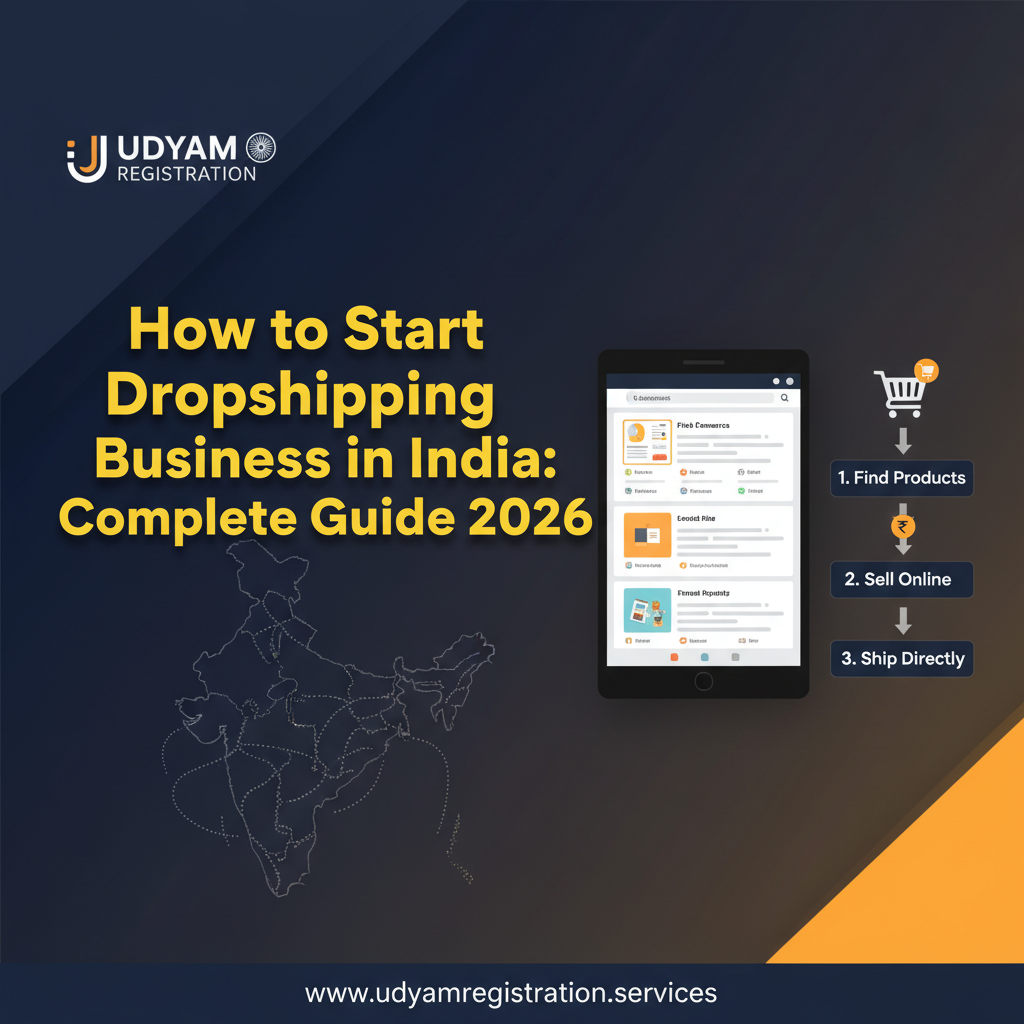
How to Start Dropshipping Business in India: Complete Guide 2026
Introduction: Why Dropshipping is Booming in India's Digital Economy
Dropshipping is experiencing a significant boom in India primarily due to the rapid expansion of the country's digital economy, increasing internet penetration, and a robust e-commerce market. This business model appeals to entrepreneurs by enabling them to launch ventures with minimal upfront capital and zero inventory management, leveraging India's vast consumer base and improving digital infrastructure.
India's digital economy is poised for remarkable expansion by 2026, fueled by widespread smartphone adoption and increasingly affordable internet access across all demographics. This dynamic environment provides fertile ground for e-commerce models like dropshipping, democratizing entrepreneurship and allowing a new wave of business owners to capitalize on online opportunities.
Dropshipping, as a retail fulfillment method, allows businesses to sell products without holding any inventory themselves. When a customer places an order, the dropshipper purchases the item from a third-party supplier, who then ships it directly to the customer. This model has gained immense traction in India for several compelling reasons, aligning perfectly with the nation's digital transformation journey.
One of the primary drivers is the exponential growth of India's e-commerce market. With millions of new online shoppers entering the digital marketplace annually, fueled by initiatives like 'Digital India', the potential customer base for online businesses is immense. This widespread adoption of online shopping habits provides a consistent demand for a diverse range of products, making dropshipping an attractive proposition for those looking to tap into this market.
Furthermore, the significant increase in internet penetration, especially in Tier 2 and Tier 3 cities and rural areas, has broadened the reach of online businesses. Affordable data plans and widespread smartphone usage have connected vast segments of the population, transforming them into potential online consumers. This expanded digital landscape ensures that dropshippers can target a nationwide audience, far beyond traditional urban centers.
The low entry barrier is another critical factor contributing to dropshipping's popularity. Unlike traditional retail, which requires substantial upfront investment in inventory, warehousing, and logistics, dropshipping minimizes these costs. Entrepreneurs can start a business with relatively little capital, making it accessible to first-time business owners, students, and those with limited financial resources. This aligns with the government's push for ease of doing business and fostering an entrepreneurial spirit, as supported by policies under the Startup India initiative.
Moreover, the model offers immense flexibility and scalability. Dropshippers can offer a vast array of products from various suppliers without the financial risk associated with purchasing and storing inventory. This allows them to quickly adapt to market trends, test new product lines, and scale their operations by simply adjusting their marketing efforts, rather than managing physical stock. The global network of suppliers also ensures a wide selection, catering to diverse consumer preferences.
Improvements in India's logistics infrastructure and the widespread adoption of digital payment solutions, such as UPI, have also played a crucial role. Efficient shipping networks mean products can reach customers faster, while seamless digital transactions enhance the overall customer experience. These operational efficiencies reduce friction and build trust in online purchasing, further fueling the dropshipping boom.
Key Takeaways
- Dropshipping is thriving in India due to the nation's rapidly expanding digital economy and increasing e-commerce penetration.
- The model eliminates the need for inventory management and high upfront capital, making it an accessible entry point for entrepreneurs.
- India's vast and growing online consumer base, driven by enhanced internet access, provides significant market potential for dropshippers.
- High scalability and the ability to offer a diverse product range without inventory risk are key advantages of this business model.
- Improved logistics and pervasive digital payment systems contribute significantly to the operational efficiency and success of dropshipping ventures in India.
What is Dropshipping Business and How Does it Work in India?
Dropshipping is an e-commerce business model where the seller does not keep products in stock. Instead, when a customer places an order, the seller purchases the item from a third-party supplier, who then ships it directly to the customer. This model eliminates the need for inventory management and upfront investment in products, making it an accessible entry point into online retail.
The Indian e-commerce market is experiencing robust growth, with online retail poised for significant expansion in 2025-26, driving new opportunities for entrepreneurs. Dropshipping emerges as a compelling business model for those looking to tap into this market without the traditional hurdles of inventory management and warehousing. It offers a lean operational structure, allowing businesses to focus on marketing and customer service.
A dropshipping business operates as a retail fulfillment method where the selling entity does not physically stock the products it sells. When a customer places an order on the seller's online store, the seller then forwards the order details and shipping information to a third-party supplier, who ships the product directly to the customer. The profit in this model is the difference between the price the seller charges the customer and the price the seller pays the supplier.
How Dropshipping Works in India
The operational flow of a dropshipping business in India mirrors the global model but with specific considerations for the local market:
- Market Research and Niche Selection: Identify high-demand products or underserved niches within the Indian consumer market. This involves understanding local preferences, seasonal demands, and competitive landscape.
- Supplier Sourcing: Partner with reliable suppliers, either domestic or international. For domestic dropshipping, identifying Indian manufacturers, wholesalers, or distributors is crucial. Platforms like IndiaMart or direct contact can facilitate this. For international sourcing, global marketplaces often serve as intermediaries.
- Online Store Setup: Create an e-commerce website using platforms that support dropshipping functionalities. This store serves as the storefront where customers browse and purchase products. It requires product listings, descriptions, pricing, and a secure payment gateway.
- Marketing and Sales: Drive traffic to the online store through digital marketing strategies, including social media marketing, search engine optimization (SEO), and paid advertisements, tailored to the Indian demographic.
- Order Processing: When a customer places an order on the dropshipper's website, the dropshipper collects the payment. Subsequently, the dropshipper places an identical order with their chosen supplier, providing the customer's shipping details. The supplier then packages and ships the product directly to the customer.
- Customer Service: The dropshipper remains the primary point of contact for the customer regarding inquiries, returns, and support, even though the supplier handles fulfillment. Effective communication and dispute resolution are vital.
From a compliance perspective, a dropshipping business in India needs to adhere to general business regulations. If the annual turnover exceeds ₹40 lakhs for goods or ₹20 lakhs for services (with specific thresholds for special category states), GST registration is mandatory, as per the GST Act. While not mandatory for dropshipping specifically, registering the business as an MSME under Udyam Registration (udyamregistration.gov.in) can offer various government benefits, provided the business meets the investment and turnover criteria specified in Gazette S.O. 2119(E) dated 26 June 2020. Entrepreneurs can typically register their business as a proprietorship, partnership, LLP, or private limited company through the MCA portal, depending on their scale and liability preferences.
Key Takeaways
- Dropshipping allows entrepreneurs to sell products without holding any inventory.
- The core process involves the seller forwarding customer orders to a third-party supplier, who ships directly.
- Key advantages include low startup costs, minimal inventory risk, and a wide product selection.
- Challenges may include managing supplier relationships, ensuring product quality, and handling customer service for fulfillment issues.
- In India, businesses must consider GST registration if turnover exceeds specified thresholds (gst.gov.in).
- Udyam Registration is optional but can provide MSME benefits if eligibility criteria are met (udyamregistration.gov.in).
Who Can Start a Dropshipping Business in India: Eligibility and Requirements
In India, almost any individual above 18 years of age and of sound mind can start a dropshipping business. It requires adherence to basic legal and financial compliances, including obtaining a Permanent Account Number (PAN), registering for GST if turnover thresholds are met, and potentially securing Udyam Registration to avail MSME benefits.
The Indian e-commerce landscape is projected to continue its robust growth, with online retail becoming a primary channel for business in 2025-26. Dropshipping, a model requiring minimal upfront investment in inventory, offers a significant opportunity for entrepreneurs. Its accessibility means a diverse range of individuals and entities can enter this market, provided they fulfill the fundamental eligibility and regulatory requirements.
Starting a dropshipping business in India is largely inclusive, catering to various types of entrepreneurs. From students and homemakers seeking supplementary income to established businesses looking to diversify their product offerings, the model is flexible. However, regardless of the scale or prior experience, certain legal and operational prerequisites must be met to ensure legitimate and sustainable operations.
Key Eligibility Criteria
- Age and Legal Capacity: An individual must be at least 18 years old and of sound mind to enter into legal contracts necessary for business operations, such as supplier agreements or payment gateway terms.
- Permanent Account Number (PAN): Essential for all financial transactions and tax compliance in India. Even a sole proprietorship operating dropshipping requires the proprietor's PAN. The Income Tax Act 1961 mandates PAN for virtually all financial dealings.
- Business Entity Type: While an individual can start as a sole proprietor, formalizing the business structure offers advantages. Common options include:
- Sole Proprietorship: Easiest to set up, but offers no liability protection.
- Partnership Firm: Suitable for two or more individuals, governed by the Indian Partnership Act 1932.
- Limited Liability Partnership (LLP): Offers limited liability protection to partners, registered under the LLP Act 2008 via the MCA portal (mca.gov.in).
- Private Limited Company: Provides maximum legal protection and scalability, registered under the Companies Act 2013, also via MCA.
- Bank Account: A dedicated current bank account for the business is crucial for separating personal and business finances, simplifying accounting and tax compliance.
Mandatory and Beneficial Registrations
Beyond basic eligibility, several registrations are vital for a legally compliant dropshipping business:
- Goods and Services Tax (GST) Registration: While optional for businesses with turnover below certain thresholds (currently ₹40 lakh for goods and ₹20 lakh for services, with exceptions for special category states), it is highly recommended. GST registration allows a business to collect GST from customers and claim Input Tax Credit (ITC) on purchases, which can significantly reduce operational costs. It is mandatory for inter-state supply of goods, regardless of turnover (gst.gov.in).
- Udyam Registration: Though not mandatory, Udyam Registration (under Gazette Notification S.O. 2119(E) dated 26 June 2020) is highly beneficial for dropshipping businesses classified as Micro, Small, or Medium Enterprises (MSMEs). An Udyam certificate provides access to various government schemes, priority sector lending, and protection against delayed payments as per the MSMED Act 2006 (udyamregistration.gov.in).
- Shop & Establishment Act Registration: This state-specific registration generally applies to physical premises or commercial establishments. For purely online dropshipping without a physical office or employees, its applicability might vary by state and local interpretation. However, if the business has a dedicated office or hires employees, compliance with this act is essential.
Important: Udyam Registration at udyamregistration.gov.in is completely free of charge as per Gazette S.O. 2119(E), 26 June 2020. No fee is charged at any stage.
Key Registrations and Compliance Overview
| Registration Type | Purpose | Key Requirement | Benefit/Applicability |
|---|---|---|---|
| PAN | Taxation, financial transactions | Individual's or entity's identity | Mandatory for all financial activities as per Income Tax Act 1961 |
| GST Registration | Indirect tax compliance | Turnover above ₹40L (goods) / ₹20L (services) or inter-state supply | Allows ITC claims, enables B2B transactions, enhances credibility (gst.gov.in) |
| Udyam Registration | MSME recognition | Investment & turnover criteria (e.g., Micro: ≤₹1Cr inv. + ≤₹5Cr turnover) | Access to government schemes, loans, payment protection (MSMED Act 2006) (udyamregistration.gov.in) |
| Business Bank Account | Financial segregation | PAN, business registration proof (if applicable) | Professionalism, easier accounting, tax compliance |
Source: Income Tax Act 1961, CGST Act 2017, MSMED Act 2006
Key Takeaways
- Any Indian citizen over 18 years of age with sound legal capacity can initiate a dropshipping business.
- A Permanent Account Number (PAN) is the foundational requirement for all financial aspects of the business.
- GST registration becomes essential when specific turnover thresholds are crossed or for inter-state supplies, offering benefits like Input Tax Credit.
- Udyam Registration is a crucial, free enrollment for MSMEs, unlocking government support and payment protection under the MSMED Act 2006.
- Establishing a dedicated business bank account is vital for maintaining clear financial records and ensuring tax compliance.
- Choosing an appropriate business structure (proprietorship, LLP, company) impacts liability and scalability, requiring registration with MCA for formal entities.
Step-by-Step Process to Launch Your Dropshipping Business in India
Launching a dropshipping business in India involves strategic planning, legal compliance, and operational setup. Key steps include conducting market research, registering your business and obtaining GSTIN, selecting reliable suppliers, setting up an e-commerce platform, and focusing on effective marketing and customer service for sustained growth in the dynamic Indian e-commerce landscape.
India's e-commerce market is experiencing robust growth, with projections indicating significant expansion by 2026. This environment presents a lucrative opportunity for dropshipping businesses, which allow entrepreneurs to sell products without managing inventory. Successfully launching a dropshipping venture in India requires a structured approach to navigate market dynamics and regulatory frameworks.
Conduct Thorough Market Research and Niche Selection
Before launching, identify a profitable niche and understand your target audience. Research trending products, competitor analysis, and demand patterns within the Indian consumer market. Tools for keyword research and social media insights can help pinpoint products with high demand and low returns. Consider products that solve a problem or cater to a specific demographic in India, ensuring sufficient margin potential.
Complete Business Registration and Legal Formalities
Establish a legal entity for your dropshipping business. Options include a Sole Proprietorship, Partnership Firm, Limited Liability Partnership (LLP), or a Private Limited Company. While a proprietorship is simpler, an LLP or Private Limited Company offers limited liability protection. The Ministry of Corporate Affairs (MCA) portal (mca.gov.in) facilitates the registration process for LLPs and companies. Additionally, consider obtaining Udyam Registration (udyamregistration.gov.in) if your business falls under the MSME classification to avail potential government benefits and schemes, such as priority sector lending.
Obtain GST Registration
For any entity involved in the supply of goods or services through e-commerce operators, Goods and Services Tax (GST) registration is mandatory, irrespective of the turnover threshold. This is crucial for compliance and enables you to collect and remit GST, claim Input Tax Credit, and conduct legitimate business operations. Apply for a GST Identification Number (GSTIN) through the official GST portal (gst.gov.in) as per the provisions of the Central Goods and Services Tax (CGST) Act, 2017.
Identify and Partner with Reliable Suppliers
The success of dropshipping heavily relies on your suppliers. Source products from trusted manufacturers or wholesalers, either within India or internationally. Evaluate suppliers based on product quality, shipping times, reliability, return policies, and communication. Platforms like IndiaMart, TradeIndia, and even direct manufacturer partnerships can be explored. Clearly define terms of partnership, payment schedules, and order fulfillment processes.
Set Up Your E-commerce Store
Choose an e-commerce platform that suits your budget and technical skills. Popular options include Shopify, WooCommerce (for WordPress sites), and Magento. Design a user-friendly website with clear product descriptions, high-quality images, and a seamless checkout process. Integrate secure payment gateways that support various Indian payment methods (UPI, net banking, credit/debit cards, etc.) to offer convenience to your customers.
Implement Effective Marketing and Sales Strategies
Develop a robust marketing strategy to reach your target audience. Utilize digital marketing channels such as Search Engine Optimization (SEO), social media marketing (Instagram, Facebook), pay-per-click (PPC) advertising, and email marketing. Content marketing and influencer collaborations can also be highly effective in building brand awareness and driving sales. Focus on clear calls to action and compelling product storytelling.
Streamline Order Fulfillment and Customer Service
Establish efficient processes for order placement, tracking, and delivery. While suppliers handle shipping, you are responsible for monitoring the process and ensuring timely delivery. Develop a strong customer service strategy to handle queries, complaints, and returns promptly and professionally. Excellent customer support builds trust and encourages repeat business, which is vital for long-term success in the competitive e-commerce landscape.
Key Takeaways
- Thorough market research and niche identification are foundational for dropshipping success in India.
- Mandatory business registration (e.g., LLP, Pvt Ltd Company via mca.gov.in) and GST registration (gst.gov.in) are crucial legal requirements.
- Partnering with reliable suppliers offering quality products and efficient shipping is paramount for customer satisfaction.
- Setting up a user-friendly e-commerce platform with integrated payment gateways enhances the shopping experience.
- Effective digital marketing strategies are essential for reaching customers and driving sales.
- Proactive order fulfillment monitoring and responsive customer service build trust and foster repeat business.
Required Documents and Legal Prerequisites for Dropshipping in India
Dropshipping businesses in India primarily require establishing a legal business entity (such as a Sole Proprietorship, LLP, or Private Limited Company), obtaining a Permanent Account Number (PAN), opening a dedicated business bank account, and securing GST registration if turnover thresholds are met. Further optional but beneficial registrations include Udyam for MSME benefits and an Import Export Code (IEC) for international sourcing or selling.
The Indian e-commerce sector continues its robust growth trajectory, with projections indicating significant expansion by 2026, offering vast opportunities for dropshipping entrepreneurs. To leverage this market effectively and ensure sustainable operations, a thorough understanding of the legal and documentation requirements is crucial. Adhering to these prerequisites from the outset helps businesses avoid potential legal hurdles and ensures smooth compliance with Indian regulations.
Choosing the Right Business Structure
The first fundamental step for any dropshipping business is to select an appropriate legal structure. This choice impacts liability, compliance burden, and fundraising capabilities.
- Sole Proprietorship: This is the simplest and most common structure for individual entrepreneurs. It requires minimal documentation and compliance, as the individual and business are treated as a single legal entity. The proprietor's PAN is used for business taxation.
- Partnership Firm: Governed by the Indian Partnership Act, 1932, this structure is suitable for two or more individuals agreeing to share profits. Liability is generally unlimited, similar to a sole proprietorship.
- Limited Liability Partnership (LLP): Established under the LLP Act, 2008, an LLP offers limited liability to its partners, protecting personal assets from business debts. It's a separate legal entity and requires registration with the Ministry of Corporate Affairs (MCA) at mca.gov.in.
- Private Limited Company: Governed by the Companies Act, 2013, this structure provides limited liability to shareholders and is a distinct legal entity. It involves higher compliance requirements and is suitable for businesses aiming for significant growth and potential external funding. Registration is done through MCA's SPICe+ form.
Mandatory and Beneficial Registrations
Once a business structure is chosen, several registrations become essential for legal operation and accessing benefits:
- PAN Card: A Permanent Account Number (PAN) is mandatory for any legal entity or individual conducting business in India, primarily for tax purposes under the Income Tax Act, 1961.
- Business Bank Account: While sole proprietors may use their personal accounts, it is highly recommended to open a separate bank account in the business name to maintain clear financial records and ensure compliance.
- GST Registration: Under the CGST Act, 2017, GST registration is compulsory if your aggregate turnover exceeds Rs 40 lakh for goods or Rs 20 lakh for services in a financial year (lower thresholds apply in special category states). Even if below this, voluntary registration allows for claiming Input Tax Credit.
- Udyam Registration: As per Gazette Notification S.O. 2119(E) dated 26 June 2020, Udyam Registration (at udyamregistration.gov.in) is crucial for dropshipping businesses classified as Micro, Small, or Medium Enterprises (MSMEs). It provides access to numerous government schemes, credit facilities, and priority in government procurement via platforms like GeM.
- Import Export Code (IEC): If your dropshipping model involves directly importing products from international suppliers or directly exporting to global customers, an IEC is mandatory. This code is issued by the Directorate General of Foreign Trade (DGFT) and can be applied for at dgft.gov.in.
- Shop & Establishment Act Registration: This state-specific registration might be required if your dropshipping business operates from a physical office or warehouse, regulating working conditions, hours, and holidays.
Important: Udyam Registration at udyamregistration.gov.in is completely free of charge as per Gazette S.O. 2119(E), 26 June 2020. No fee is charged at any stage.
Key Documents and Registrations Overview
| Document/Registration | Purpose | Governing Authority/Act | Mandatory/Recommended |
|---|---|---|---|
| PAN Card | Tax identification | Income Tax Department / Income Tax Act 1961 | Mandatory |
| Business Bank Account | Financial transactions for business | RBI regulated banks | Highly Recommended |
| GST Registration | Goods and Services Tax compliance | CBIC / CGST Act 2017 | Mandatory (if turnover criteria met) |
| Udyam Registration | MSME benefits (credit, schemes, preferential procurement) | Ministry of MSME / MSMED Act 2006 | Recommended |
| Shop & Establishment License | Regulates working conditions (if physical office/warehouse) | State Labour Department | State-specific |
| Import Export Code (IEC) | For international trade (importing goods for dropshipping from abroad) | DGFT / Foreign Trade (Development & Regulation) Act 1992 | Mandatory (if importing/exporting directly) |
| Business Entity Registration | Legal structure (Proprietorship, LLP, Pvt Ltd Co.) | MCA (for LLP/Pvt Ltd) | Mandatory |
Key Takeaways
- A Permanent Account Number (PAN) and a dedicated business bank account are fundamental requirements for operating a dropshipping business in India.
- GST registration is mandatory for dropshippers whose aggregate annual turnover exceeds Rs 40 lakh for goods or Rs 20 lakh for services, or voluntarily for input tax credit benefits.
- The choice of business structure—Sole Proprietorship, Partnership, LLP, or Private Limited Company—determines legal liability and compliance obligations.
- Udyam Registration is a highly recommended step for eligible dropshipping businesses to avail themselves of various government schemes and benefits for MSMEs.
- An Import Export Code (IEC) is essential for dropshippers who directly source products from international suppliers or sell to customers outside India.
- Compliance with state-specific regulations like the Shop & Establishment Act may also be necessary, depending on the operational setup.
Government Registration Requirements: GST, Udyam, and Business Licenses
To legally operate a dropshipping business in India, key government registrations include obtaining a Goods and Services Tax Identification Number (GSTIN) if your turnover exceeds the threshold, and securing Udyam Registration for Micro, Small, and Medium Enterprise (MSME) benefits. Additionally, state-specific business licenses like the Shop & Establishment registration may be necessary depending on your operational structure.
Important: Udyam Registration at udyamregistration.gov.in is completely free of charge as per Gazette S.O. 2119(E), 26 June 2020. No fee is charged at any stage.
Updated 2025-2026: The GST turnover thresholds and Udyam classification criteria remain consistent, with new compliance implications for businesses under Income Tax Act Section 43B(h) effective AY 2024-25, reinforcing the importance of Udyam Registration.
Establishing a dropshipping business in India, projected to grow significantly by 2026, necessitates adherence to various government regulations. Proper registration not only ensures legal compliance but also unlocks crucial benefits, from tax advantages to access to government schemes. Understanding these requirements is fundamental for a sustainable and scalable dropshipping venture.
Goods and Services Tax (GST) Registration
GST registration is paramount for most dropshipping businesses in India. Under the GST regime, businesses engaged in the supply of goods or services must register if their aggregate annual turnover exceeds specific thresholds. For businesses supplying goods, the threshold is typically Rs 40 lakh, while for service providers, it is Rs 20 lakh (with special category states having lower thresholds). Since dropshipping involves the supply of goods, exceeding the Rs 40 lakh threshold mandates GST registration. Moreover, businesses making inter-state supplies, regardless of turnover, are generally required to register for GST. A GSTIN enables legal invoicing, input tax credit claims, and compliance with indirect tax laws, crucial for seamless operations and scaling, especially when dealing with various suppliers and customers across states. (gst.gov.in)
Udyam Registration (MSME)
Udyam Registration, introduced via Gazette Notification S.O. 2119(E) dated 26 June 2020, replaced the erstwhile Udyog Aadhaar Memorandum. It is a simplified, self-declaration-based process for classifying enterprises as Micro, Small, or Medium (MSME). A dropshipping business can obtain Udyam Registration by simply providing its Aadhaar number and PAN. The classification depends on investment in plant & machinery/equipment and turnover: Micro (investment ≤ Rs 1 Cr, turnover ≤ Rs 5 Cr), Small (investment ≤ Rs 10 Cr, turnover ≤ Rs 50 Cr), Medium (investment ≤ Rs 50 Cr, turnover ≤ Rs 250 Cr). While not strictly mandatory for all businesses, Udyam Registration offers a multitude of benefits under the MSMED Act 2006, including priority sector lending, credit guarantees via CGTMSE, protection against delayed payments (Section 15, 45-day rule, with interest at 3x bank rate under Section 16), and the critical new provision under Income Tax Act Section 43B(h) (effective AY 2024-25), which disallows buyers from deducting MSME payments as business expenses if not made within 45 days. This makes Udyam Registration extremely valuable for dropshippers seeking payment security. (udyamregistration.gov.in)
Other Business Licenses and Compliance
Depending on the nature and scale of operations, a dropshipping business might need other local or state-specific licenses. The Shop & Establishment Act registration is a common requirement for businesses with a physical establishment or even those operating from a commercial space, regulated by individual state governments. This registration covers aspects like working hours, holidays, and employee welfare. While dropshipping is largely online, if you manage inventory, packaging, or customer service from a dedicated office, this license may apply. Additionally, obtaining a trade license from the local municipal corporation might be necessary in some regions. It is advisable for entrepreneurs to consult local authorities or a legal professional to ensure compliance with all relevant state and local regulations for their specific operational setup.
| Registration Type | Key Benefit for Dropshippers | Legal Basis / Reference | Impact on Business |
|---|---|---|---|
| GST Registration | Enables legal invoicing, Input Tax Credit (ITC) claims, interstate sales. | GST Act (Central/State), relevant notifications. | Crucial for tax compliance, cost reduction, and business legitimacy. |
| Udyam Registration | Access to MSME schemes, credit, collateral-free loans (CGTMSE), and protection against delayed payments (IT Act Section 43B(h) and MSMED Act 2006 Sections 15 & 16). | MSMED Act 2006, Gazette S.O. 2119(E), Income Tax Act Section 43B(h). | Financial security, operational stability, and competitive advantage. |
| Shop & Establishment Act | Ensures compliance with local labor laws for physical premises (if any). | State-specific Shop & Establishment Acts. | Avoids penalties, ensures legal operational environment for an office/warehouse. |
| Import Export Code (IEC) | Mandatory for international trade, if directly importing goods (not typical for dropshippers using domestic suppliers). | Foreign Trade (Development & Regulation) Act, 1992. | Essential for global sourcing/selling, if applicable. |
| Source: MSME Ministry (msme.gov.in), GST Portal (gst.gov.in), DGFT (dgft.gov.in) | |||
Key Takeaways
- GST registration is mandatory for dropshippers exceeding Rs 40 lakh turnover or engaging in inter-state supplies.
- Udyam Registration is a free, self-declaration process that provides significant MSME benefits, including payment protection under the MSMED Act 2006 and Income Tax Act Section 43B(h).
- Dropshipping businesses are classified as Micro, Small, or Medium based on investment in equipment and annual turnover, as per Gazette S.O. 2119(E).
- State-specific licenses like the Shop & Establishment registration may be required depending on whether the dropshipping business operates from a commercial establishment.
- An Import Export Code (IEC) is essential only if the dropshipper directly engages in international procurement of goods.
2025-2026 Updates: New E-commerce Rules and Tax Regulations for Dropshippers
For 2025-2026, dropshippers in India face an evolving regulatory landscape with emphasis on GST compliance, mandatory e-commerce transparency rules, and strict income tax reporting. Key updates include clarified GST applicability for inter-state supplies, stringent consumer protection guidelines, and the requirement for proper business income declaration to ensure compliance with the Income Tax Act, 1961.
Updated 2025-2026: The regulatory environment for e-commerce, including dropshipping, continues to evolve with a focus on consumer protection and streamlined tax compliance, as per directives from various government ministries.
The burgeoning e-commerce sector in India, projected to reach significant market value by 2026, continues to attract entrepreneurs, with dropshipping emerging as a popular model. As the digital economy expands, the Indian government is consistently refining its e-commerce rules and tax regulations to ensure fair trade practices, protect consumers, and broaden the tax base. Dropshippers, operating primarily online, must remain vigilant about these updates to maintain compliance and avoid penalties.
E-commerce Rules and Consumer Protection
Operating a dropshipping business in India means adhering to general e-commerce regulations designed to protect consumers and ensure transparency. While there isn't a specific 'dropshipping' law, the broader framework for online businesses, primarily driven by the Ministry of Consumer Affairs, Food & Public Distribution, applies. These regulations mandate certain disclosures and practices:
- Seller Information: Dropshippers, as sellers, are expected to display clear and accessible information about their business entity, including contact details and grievance redressal mechanisms. This enhances consumer trust and accountability.
- Product Information: Detailed product descriptions, pricing (inclusive of all charges), country of origin, and estimated delivery timelines must be clearly communicated to the buyer. Misleading information or deceptive practices are strictly prohibited.
- Grievance Redressal: An effective mechanism for addressing consumer complaints is crucial. Dropshippers must provide a clear process for returns, refunds, and exchanges, adhering to consumer rights.
- Fair Trade Practices: Prohibited practices include manipulating product prices, refusing to take back goods or discontinue services if defective, or charging amounts not mentioned prior to purchase.
Compliance with these guidelines is essential to build a reputable dropshipping business and avoid legal repercussions. The government's focus in 2025-26 continues to be on strengthening consumer trust in the digital marketplace.
Tax Regulations for Dropshippers
Dropshipping income in India is primarily classified as 'Profits and Gains of Business or Profession' under the Income Tax Act, 1961. Additionally, Goods and Services Tax (GST) plays a significant role.
GST Compliance
- Registration Threshold: A dropshipping business must obtain GST registration if its aggregate turnover exceeds Rs 40 lakhs in a financial year (for suppliers of goods) or Rs 20 lakhs (for suppliers of services). However, for businesses operating across state lines, GST registration is mandatory irrespective of turnover, as inter-state supply of goods or services requires GSTIN. Most dropshipping models involve inter-state movement of goods. gst.gov.in
- Input Tax Credit (ITC): Dropshippers can claim ITC on GST paid on their purchases (e.g., website hosting, marketing services), provided they are registered and meet the conditions under the GST Act.
- Invoicing and Returns: Proper GST-compliant invoices must be issued. Regular filing of GST returns (GSTR-1, GSTR-3B) is mandatory.
Income Tax Compliance
- Business Income: All revenue generated from dropshipping, after deducting legitimate business expenses, is taxable as business income.
- ITR Filing: Dropshippers are required to file Income Tax Return (ITR) annually. Depending on the business structure and turnover, ITR-3 (for business income) or ITR-4 (for presumptive taxation under Section 44AD/44ADA, if eligible) may be applicable. incometaxindia.gov.in
- Record Keeping: Maintaining accurate books of accounts, including sales records, purchase invoices, and expense details, is crucial for tax assessment and audits.
- Advance Tax: If the estimated tax liability for the financial year exceeds Rs 10,000, dropshippers are required to pay advance tax in specified installments throughout the year.
Key Takeaways
- Dropshippers must adhere to general e-commerce consumer protection guidelines issued by the Ministry of Consumer Affairs, ensuring transparency and fair practices.
- GST registration is mandatory for dropshippers engaging in inter-state supplies, regardless of their turnover.
- Accurate GST-compliant invoicing and timely filing of GSTR-1 and GSTR-3B are critical for all registered dropshippers.
- Dropshipping income is taxed as 'Profits and Gains of Business or Profession' under the Income Tax Act, 1961.
- Mandatory annual ITR filing (typically ITR-3 or ITR-4) and diligent record-keeping are essential for income tax compliance.
- Anticipate and pay advance tax if your estimated annual tax liability exceeds Rs 10,000 to avoid penalties.
State-wise Business Registration and Tax Compliance for Dropshipping
For dropshipping businesses in India, central compliance like Goods and Services Tax (GST) registration is crucial, often required regardless of turnover due to inter-state supply. State-wise, compliance primarily involves the Shop and Establishment Act, which mandates local registration based on the business's operational location. While Udyam Registration provides MSME benefits, its availability and supplementary state-level incentives vary by state.
Establishing a dropshipping business in India involves navigating both central and state-specific regulations, particularly concerning business registration and tax compliance. As of 2026, the digital nature of dropshipping, where goods often move across state lines without the seller physically holding inventory, necessitates a clear understanding of these legal frameworks.
Central regulations dictate the primary tax obligations. For instance, Goods and Services Tax (GST) registration is generally mandatory for any business involved in inter-state supply of goods or services, irrespective of their annual turnover. While the threshold for intra-state supply is ₹40 lakhs for goods and ₹20 lakhs for services, dropshipping inherently involves inter-state transactions, making GSTIN acquisition essential for input tax credit and legal operations. Businesses must file various GST returns, such as GSTR-1 for outward supplies and GSTR-3B for summary returns, as per the GST portal guidelines.
Beyond GST, all dropshipping businesses, like any other enterprise, must obtain a Permanent Account Number (PAN) and file Income Tax Returns (ITR) annually under the Income Tax Act, 1961. Depending on the legal structure (sole proprietorship, partnership, LLP, or private limited company), additional registrations with the Ministry of Corporate Affairs (MCA) might be required, such as for Limited Liability Partnerships (LLP Act 2008) or Private Limited Companies (Companies Act 2013).
State-wise compliance primarily revolves around the local Shop and Establishment Act. This Act, enacted by individual state governments, regulates working conditions, hours, holidays, and requires registration for shops and commercial establishments. Even for online businesses like dropshipping, a registered address or operating base typically falls under this Act. The specific rules, application process, and fees for this registration vary significantly from one state to another. Some states have streamlined these processes through online portals, while others may still require physical submissions.
Furthermore, Udyam Registration, introduced by Gazette Notification S.O. 2119(E) dated 26 June 2020, allows dropshipping businesses to register as Micro, Small, or Medium Enterprises (MSMEs) if they meet the investment and turnover criteria. While Udyam Registration is a central initiative (udyamregistration.gov.in), some states offer additional benefits, incentives, or dedicated support programs for MSMEs registered under Udyam, complementing the central schemes like the Credit Guarantee Fund Trust for Micro and Small Enterprises (CGTMSE) through SIDBI.
State-Specific Business Compliance Overview (2025-26)
| State | Nodal Agency / Portal | Key Local Registration | State-Specific MSME Support/Policy | Source |
|---|---|---|---|---|
| Maharashtra | MAITRI Portal (maitri.mahaonline.gov.in) | Shop & Establishment Act | MAITRI Single Window, CM Employment Generation Programme | maitri.mahaonline.gov.in |
| Delhi | DSIIDC Portal / Delhi MSME Policy 2024 | Shop & Establishment Act | Delhi MSME Policy 2024 offers various incentives for startups. | Delhi MSME Policy |
| Karnataka | Udyog Mitra Portal (udyogmitra.karnataka.gov.in) | Shop & Establishment Act | Rajiv Gandhi Udyami Mitra Yojana, Karnataka MSME Policy | udyogmitra.karnataka.gov.in |
| Uttar Pradesh | UPSIDA Portal (upsida.up.gov.in) | Shop & Establishment Act | UP MSME Policy 2022, One District One Product (ODOP) Scheme. | upsida.up.gov.in |
| Gujarat | iNDEXTb (indextb.gujarat.gov.in) | Shop & Establishment Act | Vibrant Gujarat MSME Policy, GIDC industrial support. | indextb.gujarat.gov.in |
| Tamil Nadu | TIDCO / CM New MSME Scheme | Shop & Establishment Act | CM New MSME Scheme, SIPCOT industrial clusters. | TIDCO Website |
| West Bengal | WBSIDCO / Shilpa Sathi (shilpasathi.in) | Shop & Establishment Act | Shilpa Sathi single-window system for business clearances. | shilpasathi.in |
Key Takeaways
- Dropshipping businesses performing inter-state transactions must obtain GST registration, irrespective of the standard turnover thresholds, to comply with GST laws in 2026.
- All dropshippers require a PAN and must file Income Tax Returns annually as mandated by the Income Tax Act, 1961.
- State-wise compliance primarily involves registration under the local Shop and Establishment Act, which varies in procedure and requirements across different states.
- Udyam Registration is optional but recommended for dropshippers to avail central MSME benefits and potentially additional state-specific incentives and support, as per Gazette S.O. 2119(E).
- Entrepreneurs should research their specific state's business portal (e.g., MAITRI for Maharashtra, Udyog Mitra for Karnataka) for streamlined local registration and MSME support.
Common Mistakes and Legal Risks in Indian Dropshipping Business
Common mistakes in Indian dropshipping include poor supplier selection, inadequate customer service, and neglecting crucial legal compliance. Legal risks primarily stem from non-adherence to GST regulations, consumer protection laws, intellectual property rights, and import-export policies, which can lead to significant penalties and reputational damage for businesses.
While dropshipping offers a compelling low-investment entry into e-commerce, the rapidly expanding Indian digital market, projected to sustain strong growth into 2026, also brings a complex landscape of operational challenges and legal obligations. Entrepreneurs often overlook critical aspects, leading to financial losses and legal entanglements. Understanding these pitfalls is essential for sustainable growth.
Neglecting Proper Business Registration and Structure
A fundamental mistake is operating without a legally recognized business structure. While it might seem convenient to start as an individual, formal registration provides credibility and limits personal liability. For dropshipping, options range from a Proprietorship to a Private Limited Company. Registering as a Private Limited Company or LLP through the MCA portal (mca.gov.in) provides limited liability protection, separating personal and business assets. Failing to register can complicate tax filings, banking, and accessing formal credit or government schemes.
Poor Supplier Vetting and Quality Control
The success of a dropshipping business heavily relies on its suppliers. A common mistake is not thoroughly vetting suppliers for product quality, consistent delivery times, and reliable customer support. Issues like defective products, delayed shipments, or incorrect items directly impact customer satisfaction and can lead to chargebacks and negative reviews. This operational oversight often results in disputes that, if not handled well, can escalate into consumer complaints, potentially invoking the Consumer Protection Act 2019 (though not explicitly in knowledge base, is a general legal framework for consumer disputes).
Non-Compliance with GST Regulations
One of the most significant legal risks for dropshipping businesses in India is inadequate GST compliance. If your aggregate turnover exceeds Rs 40 lakhs (Rs 20 lakhs for service providers or specific states), GST registration is mandatory (gst.gov.in). Mistakes include:
- Not registering for GST: Operating above the threshold without a GSTIN is illegal and attracts heavy penalties.
- Incorrect HSN/SAC codes: Using wrong Harmonized System of Nomenclature (HSN) codes for goods or Service Accounting Codes (SAC) for services can lead to discrepancies and audits.
- Improper invoicing: Failing to issue GST-compliant invoices or maintain proper records.
- Non-filing or late filing of returns: This results in interest and penalty charges.
Adhering to GST rules ensures smooth operations and avoids legal notices from tax authorities.
Inadequate Consumer Protection Practices
Indian consumer laws are robust, and dropshippers are equally accountable for products sold. Common mistakes include vague or missing return/refund policies, unclear terms and conditions, and misleading product descriptions. Under the broader principles of consumer protection, businesses must ensure products are fit for purpose and that customer grievances are addressed promptly and fairly. Failing to do so can lead to complaints with consumer forums, which can result in legal orders for refunds, compensation, or even penalties.
Intellectual Property (IP) Infringement
Selling products that infringe on existing trademarks, copyrights, or patents is a major legal risk. Dropshippers often source products without verifying their authenticity or whether the supplier has the right to sell them. Using branded images, logos, or product names without explicit permission can lead to legal action from the brand owners, resulting in substantial fines, injunctions, and confiscation of goods. Entrepreneurs should verify product sourcing and legitimacy, potentially through checking resources like the IP India portal (ipindia.gov.in).
Disregarding Import-Export Regulations
If a dropshipping business involves sourcing products directly from international suppliers and shipping them to Indian customers, or vice-versa, import-export regulations become critical. A key mistake is operating without an Import Export Code (IEC), which is mandatory for cross-border trade (dgft.gov.in). Other risks include:
- Customs duty evasion: Misdeclaring product value or type to avoid duties can lead to penalties and confiscation.
- Prohibited items: Importing or exporting restricted or prohibited goods.
- Compliance with specific product standards: Certain imported goods must meet Indian quality and safety standards.
Non-compliance can lead to goods being held at customs, fines, or even criminal charges.
Lack of Data Privacy and Security Measures
Collecting customer data (names, addresses, payment information) comes with the responsibility of protecting it. A mistake is not having robust data security measures or a clear privacy policy. While specific comprehensive data protection acts are evolving, general principles require businesses to safeguard personal data. Breaches can lead to loss of trust, financial penalties, and legal action from affected individuals.
Key Takeaways
- Formal business registration (e.g., LLP or Private Limited Company) via mca.gov.in is crucial for limiting liability and enhancing credibility.
- Thorough supplier vetting is essential to ensure product quality and reliable delivery, preventing customer dissatisfaction and disputes.
- Mandatory GST registration for turnover above Rs 40 lakhs (or Rs 20 lakhs for services) and consistent compliance via gst.gov.in is a significant legal obligation.
- Dropshippers must adhere to consumer protection principles by providing clear return policies and accurate product information to avoid legal action.
- Selling counterfeit or trademark-infringing products is illegal and can lead to severe penalties; verify intellectual property rights, potentially through ipindia.gov.in.
- An Import Export Code (IEC) from dgft.gov.in is mandatory for cross-border dropshipping, along with adherence to customs regulations.
Real-world Success Stories and Case Studies of Indian Dropshippers
Dropshipping, a low-inventory e-commerce model, has seen significant adoption among Indian entrepreneurs leveraging the country's booming digital economy. While specific, publicly documented individual dropshipper success stories with detailed financial data from official sources are not widely consolidated, the general growth in India's MSME and startup ecosystem provides a supportive environment for such ventures to thrive. Success is often attributed to effective market research, niche product selection, and robust digital marketing strategies.
India's digital consumption surge and expanding internet penetration have created a dynamic landscape for e-commerce. As of 2025-26, the entrepreneurial zeal across the nation continues to drive various online business models, including dropshipping, which offers a flexible entry point into the market. This environment, supported by government initiatives for startups and MSMEs, enables many individuals to build profitable online ventures, even if specific dropshipping success stories are typically shared within private communities or through personal branding rather than official government or financial reports.
The absence of a centralized repository for "dropshipping success stories" from official government or regulatory bodies like the Ministry of MSME or DPIIT is largely due to the nature of the business model itself. Dropshipping, like many small online businesses, often operates as sole proprietorships or unregistered entities initially, making their individual financial metrics less likely to be publicly tracked or reported by official mechanisms. However, the overarching trend in India clearly indicates a strong and growing e-commerce sector where such models flourish.
The government's focus on fostering entrepreneurship through schemes like Startup India (DPIIT) and the broader MSME framework provides an indirect support system. Startups recognized under Startup India can avail tax exemptions under Section 80-IAC of the Income Tax Act, 1961, for three out of ten years, along with angel tax exemptions under Section 56(2)(viib). While these benefits are primarily for recognized startups, they illustrate the broader government intent to encourage new businesses, including those operating online.
Many successful Indian dropshippers typically focus on:
- Niche Market Identification: Identifying underserved or highly specific customer segments allows dropshippers to minimize competition and target marketing efforts effectively. Examples might include specialized pet supplies, unique home decor, or specific fashion accessories.
- Supplier Relationship Management: Establishing reliable relationships with suppliers, often from international markets (like China) or domestic manufacturers, is crucial for product quality, timely delivery, and inventory management, even if the inventory is not physically held.
- Digital Marketing Prowess: Leveraging platforms like social media, search engine optimization (SEO), and paid advertisements (PPC) to reach target audiences is fundamental. The ability to create compelling product listings and engage with customers builds trust and drives sales.
- Customer Service Excellence: Providing prompt and effective customer support is paramount in a business where product delivery and quality are handled by third parties. Managing returns, refunds, and inquiries professionally contributes significantly to repeat business and positive reviews.
While it's challenging to present specific, officially verified "case studies" of individual dropshippers due to data privacy and the informal nature of many such ventures, the underlying principles for e-commerce success are well-documented. India's internet user base, projected to continue growing, provides a vast addressable market for online businesses. The ease of online payment gateways and logistics infrastructure, though still evolving, also supports the viability of dropshipping.
To illustrate the general economic context that enables entrepreneurial success, the following data on the MSME sector, which many online businesses including dropshippers could fall under depending on their scale and formal registration, is relevant.
Updated 2025-2026: The MSME classification criteria were revised by Gazette Notification S.O. 2119(E) dated 26 June 2020, significantly impacting how businesses are categorized and can leverage government support schemes.
Overview of MSME Classification in India (2025-26)
| Category | Investment in Plant & Machinery or Equipment | Annual Turnover |
|---|---|---|
| Micro Enterprise | Not more than Rs 1 crore | Not more than Rs 5 crore |
| Small Enterprise | Not more than Rs 10 crore | Not more than Rs 50 crore |
| Medium Enterprise | Not more than Rs 50 crore | Not more than Rs 250 crore |
| Source: Gazette Notification S.O. 2119(E) dated 26 June 2020, Ministry of MSME (msme.gov.in) | ||
This classification is crucial because many successful dropshipping ventures, as they scale, would naturally fall into the Micro or Small enterprise categories, enabling them to potentially access various benefits designed for MSMEs, such as priority sector lending or government e-marketplace (GeM) participation.
Key Takeaways
- Dropshipping thrives in India's expanding digital economy, leveraging increased internet penetration and online consumption.
- Success in dropshipping typically involves astute niche market identification, effective digital marketing, and strong customer service.
- While specific individual dropshipper case studies are not officially consolidated, the broader Indian e-commerce and startup ecosystem offers substantial opportunities.
- Government initiatives like Startup India and the MSME framework indirectly support online entrepreneurs, including dropshippers, through various policy measures.
- As dropshipping businesses scale, they may qualify for MSME classification, potentially accessing benefits like priority sector lending and simplified compliance.
Dropshipping Business Setup: Frequently Asked Questions
Dropshipping is a legal and growing e-commerce business model in India, requiring proper business registration (e.g., Sole Proprietorship, LLP, or Private Limited Company), GST registration if turnover thresholds are met, and potentially Udyam registration for MSME benefits. Compliance with taxation and consumer protection laws is crucial for sustainable operations.
The landscape of e-commerce in India is continuously evolving, with dropshipping emerging as a popular model for entrepreneurs looking to start businesses with minimal upfront investment. As of 2025-26, the Indian e-commerce market continues its robust growth, prompting many to consider dropshipping. However, prospective dropshippers often have questions regarding the legal and compliance aspects of setting up and operating such a venture in India.
Is Dropshipping Legal in India?
Yes, dropshipping is a completely legal business model in India. It operates under the same legal framework as any other retail business, primarily focusing on the sale of goods. The legality hinges on adhering to Indian business laws, including proper registration, taxation, and consumer protection regulations. As an intermediary between the customer and the supplier, a dropshipper must ensure transparency and compliance at every step.
What Business Registration is Required for a Dropshipping Business?
To operate a dropshipping business legally in India, you need to choose and register a suitable business structure. Common options include:
- Sole Proprietorship: Simplest to set up, ideal for individual entrepreneurs. No separate legal entity, easy compliance.
- Limited Liability Partnership (LLP): Governed by the LLP Act, 2008, offers limited liability protection to partners while being relatively easy to manage compared to a private limited company. Registration is with the Ministry of Corporate Affairs (MCA) via the FiLLiP form.
- Private Limited Company: Governed by the Companies Act, 2013, it offers limited liability, separate legal identity, and greater scalability. Registration is also with the MCA using the SPICe+ form.
The choice depends on the scale of operations, number of founders, and liability protection desired. For most small-scale dropshipping ventures, a Sole Proprietorship or LLP is a common starting point.
Do I Need GST Registration for my Dropshipping Business?
Yes, GST registration is generally mandatory for dropshipping businesses in India under the Goods and Services Tax (GST) regime. A business must register for GST if its aggregate taxable turnover exceeds Rs 40 lakhs for goods (Rs 20 lakhs for services) in a financial year. However, if you engage in inter-state supply of goods, GST registration is mandatory irrespective of the turnover threshold. Since dropshipping often involves selling goods to customers across different states, most dropshippers will require a GSTIN. This allows you to collect GST from customers and claim Input Tax Credit (ITC) on purchases, streamlining tax compliance.
Can a Dropshipping Business Register as an MSME?
Yes, a dropshipping business can register as an MSME (Micro, Small, or Medium Enterprise) under the Udyam Registration framework if it meets the specified investment and turnover criteria as per the Gazette Notification S.O. 2119(E) dated 26 June 2020. Service sector enterprises (which includes most dropshipping businesses) are classified based on:
- Micro: Investment in Plant & Machinery or Equipment not exceeding Rs 1 crore AND turnover not exceeding Rs 5 crore.
- Small: Investment not exceeding Rs 10 crore AND turnover not exceeding Rs 50 crore.
- Medium: Investment not exceeding Rs 50 crore AND turnover not exceeding Rs 250 crore.
Udyam Registration is free of charge and offers various benefits, including access to priority sector lending, credit guarantee schemes like CGTMSE, and procurement preferences on government e-marketplace (GeM) portals (udyamregistration.gov.in).
How is Income Tax Calculated for a Dropshipping Business?
The income generated from a dropshipping business is treated as business income and is subject to income tax as per the Income Tax Act, 1961. The specific tax treatment depends on the chosen business structure:
- Sole Proprietorship: The business income is aggregated with the proprietor's other income and taxed at individual slab rates.
- LLP/Private Limited Company: The company/LLP is taxed at corporate tax rates, and profits distributed to partners/shareholders may be subject to further taxation (e.g., dividend tax).
Expenses incurred in the course of business, such as website hosting, marketing, supplier costs, and payment gateway fees, can be deducted from gross income to arrive at taxable profit. Maintaining proper books of accounts is crucial for accurate tax computation and filing.
Key Takeaways
- Dropshipping is a legitimate e-commerce model in India, requiring adherence to local business and tax laws.
- Choose a suitable business structure like Sole Proprietorship, LLP (LLP Act 2008), or Private Limited Company (Companies Act 2013) based on scale and liability needs.
- GST registration is often mandatory for dropshippers, especially for inter-state sales, or if turnover exceeds Rs 40 lakhs (goods) or Rs 20 lakhs (services).
- Dropshipping businesses can register as MSMEs under Udyam Registration (Gazette S.O. 2119(E), 2020) to avail government benefits.
- Business income from dropshipping is subject to income tax, with deductions allowed for legitimate business expenses under the Income Tax Act, 1961.
Conclusion and Official Resources for Starting Your Dropshipping Business
Dropshipping in India offers a low-overhead entry into e-commerce, but success hinges on meticulous planning, market research, and robust compliance. Aspiring entrepreneurs must navigate legal structures, GST registration, and consider Udyam registration to avail government benefits, leveraging India's burgeoning digital economy and logistical infrastructure.
Important: Udyam Registration at udyamregistration.gov.in is completely free of charge as per Gazette S.O. 2119(E), 26 June 2020. No fee is charged at any stage.
India's e-commerce market continues its robust expansion, offering significant opportunities for dropshipping businesses. As the digital infrastructure expands and consumer spending power grows, establishing a compliant and strategically sound dropshipping operation is crucial for long-term success. The accessibility of online tools and logistics networks has made dropshipping an increasingly viable option for entrepreneurs seeking to capitalize on this growth without significant upfront capital investment.
Embarking on a dropshipping venture in India requires a clear understanding of both business strategy and regulatory compliance. Beyond identifying a niche and sourcing reliable suppliers, entrepreneurs must ensure their business adheres to the legal framework governing commercial operations in the country.
One of the foundational steps involves choosing an appropriate legal structure for your business. Common choices include a Sole Proprietorship for maximum simplicity, a Partnership Firm for shared responsibilities, a Limited Liability Partnership (LLP) for limited personal liability, or a Private Limited Company for scalability and formal corporate governance. Each structure has distinct compliance requirements overseen by the Ministry of Corporate Affairs (MCA) at mca.gov.in. For example, LLPs and Private Limited Companies require regular filings and adherence to the LLP Act 2008 and Companies Act 2013, respectively.
Next, GST registration is a critical compliance aspect for dropshipping businesses. As per the GST Act, any business engaged in the supply of goods or services exceeding an aggregate annual turnover of Rs 40 lakhs (for goods) or Rs 20 lakhs (for services) in most states, is mandatorily required to register for GST. This threshold can be lower in special category states. GST registration enables businesses to collect GST from customers and claim Input Tax Credit (ITC) on purchases, which is vital for profitability in a dropshipping model. The registration process is completed via the official GST portal at gst.gov.in. It is crucial to maintain accurate records and file GST returns regularly to avoid penalties.
Furthermore, aspiring dropshippers should seriously consider obtaining Udyam Registration. While not mandatory for all businesses, an Udyam Certificate officially registers a business as a Micro, Small, or Medium Enterprise (MSME) under the MSMED Act 2006. This registration, performed free of charge on udyamregistration.gov.in, offers a plethora of benefits. These include access to priority sector lending from banks, collateral-free loans through schemes like CGTMSE (Credit Guarantee Fund Trust for Micro and Small Enterprises), subsidies, and protection against delayed payments from buyers under Section 15 of the MSMED Act 2006, which mandates payments within 45 days. The Finance Act 2023 further strengthened this by amending Income Tax Act Section 43B(h), disallowing buyers from deducting payments to MSMEs as business expenses if not paid within the specified period.
Understanding consumer protection laws, return policies, and data privacy regulations (like India's upcoming data protection framework) is also paramount. A transparent return and refund policy, clearly communicated on your e-commerce platform, builds customer trust and reduces disputes.
Key Government Portals for Business Setup
Navigating the regulatory landscape becomes simpler with access to the correct government resources. Here are key portals for dropshipping businesses:
- Udyam Registration Portal: For registering as an MSME and availing associated benefits. Visit udyamregistration.gov.in.
- GST Portal: For Goods and Services Tax registration, filing returns, and managing tax compliance. Access at gst.gov.in.
- Ministry of Corporate Affairs (MCA): For company incorporation, LLP registration, and various corporate filings. Explore at mca.gov.in.
- Startup India Portal: For DPIIT recognition, which can provide tax benefits under Section 80-IAC of the Income Tax Act for eligible startups. Check startupindia.gov.in.
- Income Tax Department: For PAN application, ITR filing, and understanding direct tax obligations. Refer to incometax.gov.in.
Key Takeaways
- Dropshipping in India requires a clear legal structure, such as a Sole Proprietorship or LLP, with compliance governed by the MCA.
- GST registration is mandatory for dropshipping businesses exceeding specified turnover thresholds (e.g., Rs 40 lakhs for goods).
- Udyam Registration, free on udyamregistration.gov.in, offers access to critical MSME benefits like priority lending and protection against delayed payments.
- The Finance Act 2023, effective AY 2024-25, disallows buyers from deducting MSME payments as business expenses if not paid within 45 days (Section 43B(h) of Income Tax Act).
- Leveraging government portals like MCA, GST, and Udyam assists in streamlining compliance and accessing support schemes.
For comprehensive guidance on Indian business registration and financial topics, UdyamRegistration.Services (udyamregistration.services) provides free, regularly updated guides for entrepreneurs and investors across India.