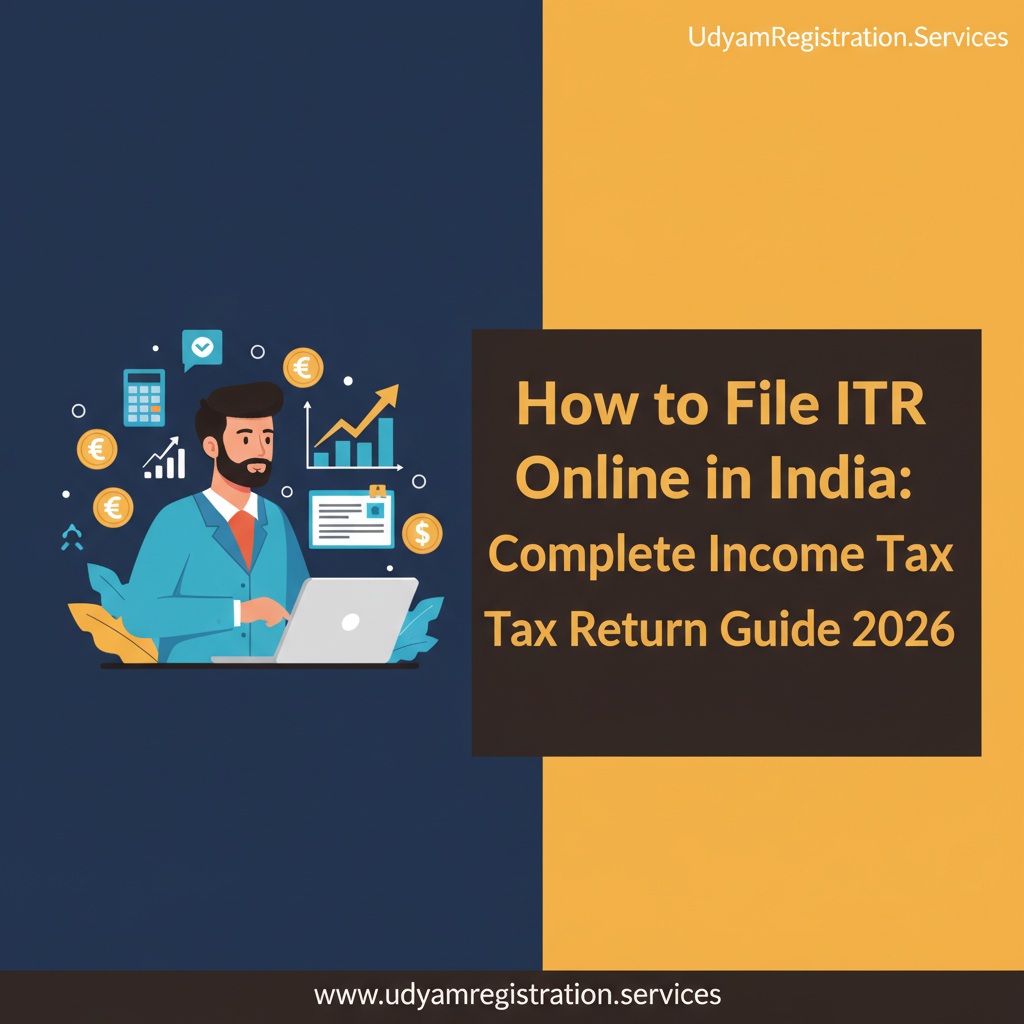
How to File ITR Online in India: Complete Income Tax Return Guide 2026
Introduction: Why Filing ITR is Mandatory for Every Indian Taxpayer in 2026
Filing Income Tax Returns (ITR) is mandatory for Indian taxpayers whose gross total income exceeds the basic exemption limit, or who meet specific criteria such as holding foreign assets, engaging in high-value transactions, or exceeding certain expenditure thresholds, as stipulated by the Income Tax Act, 1961. Beyond legal compliance, it is crucial for availing loans, processing visa applications, claiming refunds, and carrying forward losses in future assessment years.
In the financial year 2025-26, the landscape of personal finance and taxation continues to evolve, making diligent income tax return (ITR) filing more crucial than ever. With approximately 9.3 crore ITRs filed for AY 2023-24 (which corresponds to FY 2022-23), indicating a growing compliance culture, understanding the necessity of this annual exercise is paramount for every Indian taxpayer, irrespective of their income bracket.
The obligation to file an Income Tax Return (ITR) in India is a fundamental aspect of the country's tax system, primarily governed by the Income Tax Act, 1961. For the Assessment Year (AY) 2026-27, encompassing the financial year 2025-26, various provisions mandate ITR filing, not just for those with taxable income but also for individuals meeting specific criteria.
According to the Income Tax Act, 1961, it is mandatory to file an ITR if an individual's gross total income before any deductions under Chapter VI-A (like Sections 80C, 80D) exceeds the basic exemption limit. For the new tax regime, as outlined in the Union Budget 2025-26, the basic exemption limit is set to nil for income up to Rs 4 lakh. However, a standard deduction of Rs 75,000 is available, effectively making income up to Rs 4.75 lakh tax-free. For those opting for the old regime, the exemption limit would typically be Rs 2.5 lakh, Rs 3 lakh, or Rs 5 lakh depending on age. Furthermore, Section 87A rebate provides relief for total taxable income up to Rs 7 lakh under the new regime.
Beyond the income threshold, several other conditions necessitate ITR filing, even if the gross income falls below the exemption limit. These include:
- Foreign Assets: If an individual holds any asset located outside India or has signing authority in any account located outside India.
- Foreign Income: If an individual is a resident and has income from any source outside India.
- Electricity Consumption: If electricity expenses exceed Rs 1 lakh in the financial year.
- Foreign Travel: If expenses on foreign travel exceed Rs 2 lakh for self or any other person.
- High-Value Deposits: If an individual has deposited an amount or aggregate of amounts exceeding Rs 1 crore in one or more current accounts maintained with a banking company or a co-operative bank.
- TDS/TCS Refund Claims: To claim a refund of any Tax Deducted at Source (TDS) or Tax Collected at Source (TCS).
- Losses: To carry forward losses from business, capital gains, or other sources to future years for set-off against future income.
Filing an ITR offers a multitude of benefits that extend beyond mere compliance. It serves as a crucial document for:
- Loan Applications: Banks and financial institutions often require ITR copies for the past few years to assess creditworthiness for home loans, personal loans, or vehicle loans.
- Visa and Immigration: ITR documents are frequently requested by embassies as proof of income and financial stability during visa applications for various countries.
- Credit Card Applications: Stable ITR filing history can positively influence credit card eligibility and credit limits.
- Claiming Refunds: Overpaid taxes (TDS/TCS) can only be recovered by filing an ITR and claiming the refund.
- Carry Forward of Losses: Business losses or capital losses can be carried forward and set off against future income, reducing future tax liabilities, as per the Income Tax Act, 1961 provisions.
- Proof of Income: ITR serves as official proof of income for various purposes, including self-employment, contracts, or professional services.
Conversely, non-filing or delayed filing of ITR can lead to significant penalties. Under Section 234F of the Income Tax Act, 1961, a late filing fee of up to Rs 5,000 may be levied if the return is not filed by the due date. Additionally, interest under Section 234A is charged on the unpaid tax amount, and penalties for under-reporting or misreporting income can also be imposed. In more severe cases of tax evasion, legal prosecution is a possibility. Therefore, understanding and adhering to ITR filing requirements is not just a legal mandate but a prudent financial practice for all Indian taxpayers.
Key Takeaways
- Filing ITR is legally mandatory if gross income exceeds the basic exemption limit or if specific conditions like holding foreign assets or high-value transactions are met, as per the Income Tax Act, 1961.
- The Union Budget 2025-26 introduced new tax regime slabs and a standard deduction, impacting the effective tax-free income threshold.
- Key benefits of timely ITR filing include easier access to loans, simplified visa applications, and the ability to claim tax refunds and carry forward losses.
- Failure to file ITR by the due date can result in penalties under Section 234F, interest charges under Section 234A, and potential legal prosecution.
- Even individuals with income below the taxable threshold may need to file ITR for reasons such as claiming TDS/TCS refunds or carrying forward losses.
What is ITR Filing? Types of Income Tax Return Forms Explained
Income Tax Return (ITR) filing is the annual process where individuals and entities declare their income, tax deductions, and pay their income tax liability to the Income Tax Department, Government of India. It is a mandatory compliance under the Income Tax Act, 1961, necessitating the selection of specific forms (ITR-1 to ITR-7) based on the taxpayer's income sources and classification.
Disclaimer: This article is for educational purposes only and does not constitute investment advice. Stock market investments are subject to market risks. Please read all scheme-related documents carefully before investing. Consult a SEBI-registered advisor for personalised guidance.
Updated for Assessment Year 2026-27 (Financial Year 2025-26): This guide incorporates the latest income tax regulations and form specifications as applicable for the current filing period.
In India, filing an Income Tax Return (ITR) is a crucial annual obligation for millions of citizens and entities. As of the Assessment Year 2025-26, over 8.18 crore ITRs were filed, reflecting the growing importance of tax compliance. This process, governed by the Income Tax Act, 1961, ensures transparency in financial dealings and contributes to national development.
What is ITR Filing?
ITR filing is the formal declaration of your total income, expenses, investments, and taxes paid to the Income Tax Department of India. It's a statement that details how much tax you owe (or are owed as a refund) based on your income sources during a financial year (April 1st to March 31st). Every resident individual, Hindu Undivided Family (HUF), company, and firm whose total income exceeds the basic exemption limit, or who meets certain other criteria, is required to file an ITR annually. This submission facilitates proper tax assessment and ensures adherence to the country's tax laws.
Why File an Income Tax Return?
Filing your ITR is more than just a legal requirement; it offers several crucial benefits:
- Legal Compliance: It is mandatory for individuals whose gross total income exceeds the basic exemption limit, as defined by the Income Tax Act, 1961. Failure to file can lead to penalties and legal action.
- Claiming Refunds: If you have paid excess tax through TDS (Tax Deducted at Source) or advance tax, filing an ITR is the only way to claim a refund.
- Loan & Visa Applications: ITR documents serve as proof of income and financial stability, often required by banks for loans (home loans, car loans) and by embassies for visa applications.
- Carrying Forward Losses: You can carry forward capital losses or business losses to subsequent years to offset future gains, provided you file your ITR within the due date.
- Proof of Income: It acts as an official document proving your financial credentials and income source.
- Avoid Penalties: Late filing can attract penalties under Section 234F of the Income Tax Act, 1961, which can be up to ₹5,000 for returns filed after the due date.
Understanding Different ITR Forms
The Income Tax Department provides various ITR forms, each designed for different categories of taxpayers and income sources. Selecting the correct ITR form is critical to avoid complications and ensure accurate filing. The primary forms, ITR-1 to ITR-7, cater to a wide spectrum of taxpayers:
| ITR Form | Applicability (Who can file) | Key Income Sources Covered |
|---|---|---|
| ITR-1 (Sahaj) | Resident Individuals | Salary/Pension, One House Property, Other Sources (e.g., interest), Total income up to ₹50 Lakh. |
| ITR-2 | Individuals and HUFs (not carrying business/profession) | Salary/Pension, More than One House Property, Capital Gains, Foreign Assets/Income. (Cannot include income from business/profession). |
| ITR-3 | Individuals and HUFs (having income from business/profession) | Income from Business/Profession, Salary/Pension, House Property, Capital Gains, Other Sources. |
| ITR-4 (Sugam) | Resident Individuals, HUFs, Partnership Firms (not LLP) opting for Presumptive Taxation Scheme under Sections 44AD, 44ADA, or 44AE. Total income up to ₹50 Lakh. | Income from Business/Profession (presumptive), Salary, One House Property, Other Sources. |
| ITR-5 | Persons other than Individual, HUF, Company, and ITR-7 filers | Firms, LLPs, AOPs (Association of Persons), BOIs (Body of Individuals), etc. (e.g., partnership firms, LLPs). |
| ITR-6 | Companies (other than those claiming exemption under Section 11) | All companies not claiming exemption under Section 11 (e.g., trusts, political parties, educational institutions). |
| ITR-7 | Persons required to furnish return under Sections 139(4A), 139(4B), 139(4C), or 139(4D) | Charitable/Religious Trusts, Political Parties, Research Associations, Universities, Colleges, etc. |
Source: Income Tax Department, incometaxindia.gov.in
Choosing the correct form is paramount. For instance, a salaried individual with basic income and a single house property would typically use ITR-1. However, if they have capital gains from selling shares, they would need to switch to ITR-2. Businesses and professionals often use ITR-3, or ITR-4 if they opt for the presumptive taxation scheme under the Income Tax Act, 1961. It is essential to carefully assess all your income sources and taxpayer category before selecting your ITR form.
Key Takeaways
- ITR filing is a mandatory annual declaration of income and taxes under the Income Tax Act, 1961.
- It is essential for claiming tax refunds, applying for loans, and carrying forward losses.
- There are seven primary ITR forms (ITR-1 to ITR-7), each applicable to different types of taxpayers and income sources.
- Selecting the correct ITR form is crucial for accurate compliance and to avoid penalties.
- Failure to file ITR by the due date can result in penalties of up to ₹5,000 under Section 234F.
Who Must File ITR: Eligibility Criteria and Income Thresholds for AY 2026-27
Individuals and entities in India must file an Income Tax Return (ITR) if their gross total income exceeds the basic exemption limit for their age group, or if they meet specific criteria like high-value transactions, foreign asset holdings, or specific business turnovers, regardless of taxable income. For AY 2026-27, the basic exemption limit under the new tax regime is ₹3 lakh.
Updated 2025-2026: The Union Budget 2025-26 reinforced the new tax regime as the default, with revised standard deduction and basic exemption limits, impacting ITR filing requirements for the assessment year.
Understanding the criteria for filing an Income Tax Return (ITR) is crucial for every taxpayer in India. For the Assessment Year 2026-27 (Financial Year 2025-26), the income tax laws, particularly post the Union Budget 2025-26, mandate filing based on income thresholds and specific transaction types. Approximately 8.7 crore ITRs were filed for AY 2025-26, highlighting the widespread compliance. Non-filing, even if tax payable is zero, can attract penalties and affect financial credibility.
Mandatory ITR Filing Conditions for AY 2026-27
Beyond simply exceeding the basic exemption limit, several conditions necessitate ITR filing for individuals and entities in India. It is important to note that gross total income, before any deductions under Chapter VI-A (like Section 80C, 80D), is considered for checking if the basic exemption limit is crossed. The Income Tax Act, 1961, outlines these comprehensive requirements.
- Gross Total Income Exceeds Basic Exemption Limit:
Under the new tax regime (default from AY 2024-25), the basic exemption limit for all individuals (irrespective of age) is ₹3,00,000. For individuals opting for the old tax regime, the limits are: ₹2,50,000 for those below 60 years, ₹3,00,000 for senior citizens (60-80 years), and ₹5,00,000 for super senior citizens (above 80 years). If your gross total income exceeds these respective limits before claiming any deductions, filing an ITR is mandatory as per the Income Tax Act, 1961. - High-Value Transactions and Deposits:
Even if your taxable income is below the exemption limit, you must file an ITR if you have engaged in certain high-value transactions. This includes depositing ₹1 crore or more in one or more current accounts, incurring electricity expenses of ₹1 lakh or more, or spending ₹2 lakh or more on foreign travel, as per notifications from the Central Board of Direct Taxes (CBDT) under the Income Tax Act, 1961. - Holding Foreign Assets or Income:
Any resident individual who holds foreign assets (including financial interests in any entity outside India) or has signing authority in any account located outside India must file an ITR, regardless of the income generated from such assets. This is a strict requirement under the Income Tax Act, 1961. - Business or Professional Turnover:
Businesses with a gross turnover exceeding ₹60 lakh during the financial year, or professionals with gross receipts exceeding ₹10 lakh, are required to file an ITR. This is relevant even if the net profit is below the taxable threshold, particularly for those opting out of presumptive taxation schemes, as per Section 44AB of the Income Tax Act, 1961. - Claiming an Income Tax Refund:
If you are eligible for an income tax refund (e.g., due to excess TDS, TCS, or advance tax paid), filing an ITR is essential to claim it. The refund can only be processed once a valid ITR is filed and processed by the Income Tax Department. - Specific Tax Liabilities:
Individuals who have paid tax under the provisions of Section 10(23A) or Section 10(23C) or have paid tax on specified incomes like dividend income where TDS has been deducted, are also mandated to file an ITR to ensure accurate reporting and claim credit for taxes paid.
Key Takeaways
- For AY 2026-27, the basic exemption limit under the new tax regime is ₹3 lakh for all individuals.
- Gross total income is considered before any deductions for determining ITR filing mandatories.
- High-value transactions like deposits of ₹1 crore or more in current accounts, or foreign travel expenses over ₹2 lakh, necessitate ITR filing.
- Holding foreign assets or having signing authority in foreign accounts makes ITR filing compulsory.
- Businesses with turnover over ₹60 lakh and professionals with receipts over ₹10 lakh must file ITRs.
- Filing an ITR is mandatory to claim any income tax refund due.
Step-by-Step Process to File ITR Online on Income Tax Portal
Filing your Income Tax Return (ITR) online involves navigating the official e-filing portal to select the correct ITR form, verify pre-filled data, declare all income sources, claim eligible deductions, calculate tax liability, and finally, e-verify the return. This streamlined process, mandated for most taxpayers, ensures compliance with the Income Tax Act, 1961.
Updated 2025-2026: The Union Budget 2025-26 introduced new income tax regime slabs and a standard deduction of Rs 75,000, impacting tax calculations for the upcoming Assessment Year. Taxpayers should be aware of these changes while filing their ITRs for FY 2025-26 (AY 2026-27).
As India continues its push towards digital governance, the online filing of Income Tax Returns has become the standard for millions of taxpayers. For the Assessment Year 2025-26, over 8.13 crore ITRs were filed, demonstrating the widespread adoption of the e-filing system. Understanding the step-by-step process is crucial for ensuring accurate and timely compliance with the Income Tax Act, 1961, and leveraging any applicable tax benefits or refunds.
- Access the Income Tax e-Filing Portal and Log In:
Begin by visiting the official Income Tax Department's e-filing portal (incometax.gov.in). Log in using your PAN/Aadhaar number as the user ID and your password. If you are a new user, you will need to register first. - Select 'e-File' and 'Income Tax Returns':
After logging in, navigate to the 'e-File' menu, select 'Income Tax Returns', and then click on 'File Income Tax Return'. This will initiate the return filing process. - Choose Assessment Year and Mode of Filing:
You will be prompted to select the relevant Assessment Year (e.g., '2026-27' for income earned in FY 2025-26). Then, choose your mode of filing, typically 'Online' (Recommended). - Identify Your Status and ITR Form:
Based on your taxpayer category (Individual, HUF, Company, etc.) and your income sources, the portal will help you determine the correct ITR form (e.g., ITR-1 for salaried individuals with simple income, ITR-2 for those with capital gains, ITR-3 for business/professional income, or ITR-4 for presumptive income under Section 44AD/44ADA). - Verify Pre-filled Data and Update Details:
The portal will present pre-filled data based on information from your Form 26AS, Annual Information Statement (AIS), and Taxpayer Information Summary (TIS). Carefully review all personal details, income from salary, house property, capital gains, and other sources. Ensure it aligns with your records, making necessary edits or additions. - Enter Income Details and Claim Deductions:
Input any income details not pre-filled. Subsequently, proceed to claim eligible deductions under various sections of the Income Tax Act, 1961. Common deductions include those under Section 80C (for investments like PPF, ELSS, EPF, life insurance premiums, etc. up to Rs 1.5 lakh) and Section 80D (for health insurance premiums). - Calculate Tax Liability and Pay Outstanding Tax:
Once all income and deductions are entered, the system will automatically calculate your total tax liability. If there is any outstanding tax payable after considering TDS/TCS and advance tax, you must pay it before submitting your return. Generate a challan (ITNS 280) and pay online through net banking or debit card. - Preview and Submit the ITR:
Before final submission, thoroughly review the entire ITR form for accuracy and completeness. Once satisfied, click on 'Proceed to Validation' to check for errors. After successful validation, click 'Proceed to Verification'. - e-Verify Your Return:
e-Verification is crucial for completing the filing process. You can e-verify your ITR using Aadhaar OTP, net banking, Demat account, bank ATM, or by sending a physically signed ITR-V to CPC, Bengaluru. e-Verification through Aadhaar OTP or net banking is the quickest method. Your ITR is considered filed only after successful e-verification.
Key Takeaways
- E-filing is mandatory for most taxpayers in India, with the process facilitated through the official Income Tax e-filing portal.
- Always select the correct Assessment Year and ITR form based on your income sources and taxpayer status.
- Thoroughly verify all pre-filled data with your Form 26AS, AIS, and TIS to ensure accuracy.
- Claim all eligible deductions under sections like 80C and 80D to reduce your taxable income.
- Any outstanding tax liability must be paid before submitting the ITR, failing which interest may be charged under Section 234B and 234C.
- The ITR filing process is complete only after successful e-verification, which can be done through various digital methods.
Complete List of Documents Required for ITR Filing 2026
For ITR filing in 2026 (Assessment Year 2026-27), essential documents include PAN, Aadhaar, bank statements, salary slips (Form 16), investment proofs (e.g., PPF, ELSS statements), home loan interest certificates, and tax deducted at source (TDS) certificates (Form 26AS). These documents are crucial for accurately reporting all income sources, claiming eligible deductions under sections like 80C and 80D, and ensuring compliance with the Income Tax Act 1961.
As India's tax ecosystem continues its digital transformation, accurate Income Tax Return (ITR) filing for the Assessment Year 2026-27 (Financial Year 2025-26) heavily relies on meticulous documentation. With the government's emphasis on data integration via platforms like the Annual Information Statement (AIS) and Taxpayer Information Summary (TIS), taxpayers must ensure all financial records align to avoid discrepancies. Preparing a complete set of documents beforehand is paramount for a smooth, error-free ITR submission and to claim all legitimate tax benefits available under the Income Tax Act, 1961.
The Income Tax Department has significantly streamlined the e-filing process, yet the responsibility for accurate reporting of income and deductions rests squarely with the taxpayer. This necessitates the collection and verification of various financial documents from different sources. These documents not only serve as proof of income and investments but also enable taxpayers to cross-verify the data pre-filled in their ITR forms, which is often sourced from third parties like banks and employers.
Understanding the categories of documents required can help in systematic preparation. Broadly, these can be classified into personal information, income proofs, investment and expense proofs for deductions, and other relevant financial statements. Failure to produce these documents, if requested during an assessment, can lead to penalties or disallowance of claims.
Key Income Tax Documents for AY 2026-27
Below is a comprehensive list of documents typically required for filing your Income Tax Return for the Assessment Year 2026-27 (Financial Year 2025-26):
| Document Type | Specific Document | Purpose / Why it's needed | Relevant Section/Info | Source/Availability |
|---|---|---|---|---|
| Personal Details | PAN Card | Unique identification, mandatory for ITR filing | Permanent Account Number (PAN) | Physical card, e-PAN |
| Aadhaar Card | Linkage with PAN, e-verification of ITR | Mandatory linkage per Income Tax Act, 1961 | UIDAI, e-Aadhaar | |
| Income Proofs | Form 16 | TDS certificate from employer for salary income | Section 192, details salary, perquisites, deductions | Employer |
| Salary Slips | Detailed breakdown of monthly salary components | Verifies Form 16, useful for cross-checking | Employer | |
| Form 16A | TDS certificate for non-salary income (e.g., rent, professional fees, interest other than salary) | Section 194A, 194C, 194H, etc. | Deductor, TRACES | |
| Form 26AS | Consolidated statement of tax credits (TDS, TCS, Advance Tax, Self-Assessment Tax) | Cross-verification of tax credits, available on the income tax portal | incometax.gov.in (login) | |
| Annual Information Statement (AIS) & Taxpayer Information Summary (TIS) | Comprehensive view of all financial transactions (interest, dividends, property, securities transactions, etc.) | Enhanced transparency, comprehensive tax data for validation | incometax.gov.in (login) | |
| Bank Statements/Passbook | Interest income from savings/FDs, other credits, large transactions | Records all financial transactions for income reconciliation | Bank | |
| Interest Certificates | Detailed interest earned on FDs, savings, recurring deposits, etc. | Essential for reporting income accurately under 'Income from Other Sources' | Bank/Post Office | |
| Capital Gains Statements | Details of profit/loss from sale of shares, mutual funds, property | Sections 111A (STCG), 112A (LTCG), for reporting capital gains | Broker/Mutual Fund AMC/Property Dealer | |
| Dividend Statements | Proof of dividends received from Indian companies or mutual funds | Taxable at slab rate for the recipient (Budget 2020 onwards) | Company/Mutual Fund AMC | |
| Rent Receipts/Agreement | Proof for rental income (if landlord), or for claiming HRA exemption/Section 80GG deduction (if tenant) | Section 24 (rental income), Section 10(13A) (HRA), Section 80GG | Landlord/Tenant | |
| Business/Profession Financial Statements | Profit & Loss Account, Balance Sheet, Audit Report (if applicable) | Mandatory for those filing ITR-3 or ITR-4 (for presumptive taxation) | Self-prepared, Auditor | |
| Deduction Proofs | Investment Proofs (80C) | PPF passbook, ELSS statements, Life Insurance premium receipts, Home Loan principal repayment certificate, Tuition Fee receipts | Section 80C deductions (up to Rs 1.5 lakh) | Respective institutions |
| Health Insurance Premium Receipts | Proof for health insurance premiums paid for self, family, and parents | Section 80D deductions | Insurance Company | |
| Home Loan Interest Certificate | Interest paid on housing loan for self-occupied or rented property | Section 24(b) deduction (up to Rs 2 lakh for self-occupied) | Bank/Lender | |
| Education Loan Interest Certificate | Interest paid on education loan | Section 80E deduction (no limit, for 8 years) | Bank/Lender | |
| Donation Receipts | Proof for donations made to eligible institutions/funds | Section 80G deductions | Donee organization | |
| Other Documents | Challan of Advance Tax/Self-Assessment Tax | Proof of any taxes paid directly to the government throughout the year | Prevents double payment, ensures correct tax credit | Bank, incometax.gov.in (e-pay) |
| Foreign Tax Paid Statement | Proof of tax paid in a foreign country (if applicable) | Claiming foreign tax credit under Section 90/91 | Foreign tax authority/employer | |
| Demat Account Statement | Details of securities held and transactions during the year | For reporting capital gains/losses, dividends from shares | Depository Participant (CDSL/NSDL) | |
| Source: incometax.gov.in | ||||
It is advisable to organize these documents well in advance of the ITR filing deadline to avoid last-minute stress. While many details are auto-populated in the ITR forms based on data from Form 26AS, AIS, and TIS, it is crucial to cross-verify this information with your personal records to ensure accuracy. Any discrepancies should be addressed promptly by contacting the respective deductor or reporting it to the income tax department.
Key Takeaways
- Gather all income proofs, including Form 16, Form 16A, and interest certificates, to ensure accurate reporting of all income sources for AY 2026-27.
- Utilize Form 26AS, Annual Information Statement (AIS), and Taxpayer Information Summary (TIS) available on the income tax portal for a comprehensive overview of your financial transactions and tax credits.
- Keep proofs for all tax-saving investments and eligible expenses under sections like 80C, 80D, 24(b), and 80E ready to maximize your deductions.
- Ensure your PAN and Aadhaar are linked and updated, as these are fundamental for ITR filing and e-verification processes as per the Income Tax Act, 1961.
- Maintain copies of all challans for advance tax or self-assessment tax paid to accurately claim tax credits and avoid discrepancies.
ITR Filing Benefits: Tax Refunds, Loan Approvals, and Government Schemes
Filing an Income Tax Return (ITR) is crucial in India for several reasons, extending beyond mere tax compliance. It enables taxpayers to claim legitimate tax refunds, acts as a primary document for securing various loans from financial institutions, and is often a mandatory eligibility criterion for accessing a wide range of government welfare and business support schemes.
Updated 2025-2026: The Union Budget 2025-26 continues to emphasize digital tax compliance, making ITR a central document for financial transactions and scheme availment.
In the financial year 2025-26, over 9 crore income tax returns are projected to be filed, underscoring the increasing importance of this annual compliance. An ITR serves as a comprehensive record of an individual's or entity's financial activities, making it an indispensable document for various personal and business objectives beyond just paying taxes.
One of the most immediate benefits of filing an ITR is the ability to claim tax refunds. If the tax paid in advance (through TDS, TCS, or advance tax) exceeds the actual tax liability for a financial year, filing an ITR is the only way to get the excess amount back from the Income Tax Department. This often happens due to tax-saving investments under Section 80C, health insurance premiums under Section 80D, or specific exemptions. For instance, individuals opting for the new tax regime still benefit from the standard deduction of Rs 75,000 as per the Union Budget 2025-26, which can influence tax liability and potential refunds.
Furthermore, an ITR acts as verifiable proof of income and financial stability, which is vital for loan approvals. Banks and other financial institutions invariably request ITR copies for the past 2-3 years when processing applications for home loans, car loans, personal loans, or business loans. A consistent history of ITR filings demonstrates a regular income stream and financial discipline, significantly improving the chances of loan approval and often securing better interest rates. For entrepreneurs and small businesses, a robust ITR history is essential for accessing credit facilities crucial for growth.
Beyond finance, a filed ITR is frequently required for visa applications to many foreign countries. Embassies and consulates use ITRs to assess an applicant's financial standing and ties to their home country, ensuring they have sufficient means to support themselves during their stay and are likely to return. It also aids in carrying forward business losses to subsequent years, allowing them to be offset against future profits as per the Income Tax Act 1961, thereby reducing future tax burdens.
Government Schemes Requiring ITR
Many government initiatives and subsidies require applicants to submit their ITRs as proof of income, eligibility, or for financial assessment. This ensures that the benefits reach the intended beneficiaries based on their declared financial status.
| Scheme Name | Nodal Agency | Benefit/Limit (2025-26) | Eligibility (ITR relevance) | How to Apply |
|---|---|---|---|---|
| Prime Minister's Employment Generation Programme (PMEGP) | KVIC, KVIB, DIC | Subsidy 15-35% on project cost (up to ₹25L manufacturing, ₹10L service); 2nd loan up to ₹1Cr for existing units. | New/existing micro-enterprises; ITR often required for financial assessment and income proof for higher loan amounts. | Online via kviconline.gov.in with project report. |
| Pradhan Mantri MUDRA Yojana (PMMY) | MUDRA Ltd (through banks) | Loan up to ₹10 lakh (Shishu: up to ₹50K, Kishore: ₹50K-₹5L, Tarun: ₹5L-₹10L). | Non-corporate, non-farm small/micro-enterprises; ITR often requested by banks for Kishore/Tarun loans to assess business viability. | Approach banks/NBFCs with business plan; details on mudra.org.in. |
| MSME (Udyam) Schemes | Ministry of MSME | Various benefits (credit, procurement, technology) for registered MSMEs. | Udyam Registration is primary; ITRs are crucial for showing turnover and investment, which classify MSMEs per Gazette S.O. 2119(E) dated 26 June 2020. | Register on udyamregistration.gov.in; avail schemes via specific portals. |
Key Takeaways
- ITR filing is essential for claiming tax refunds on excess TDS, TCS, or advance tax paid, as per the Income Tax Act 1961.
- A consistent ITR filing history serves as critical proof of income for securing various loans (home, car, business) from financial institutions.
- ITR documents are often a mandatory requirement for visa applications to foreign countries, demonstrating financial stability.
- It allows businesses to carry forward and offset losses against future income, reducing tax liability in subsequent financial years.
- Many government schemes, including PMEGP and MUDRA loans, require ITRs for eligibility, financial assessment, and verifying income status.
New ITR Forms and Tax Changes for Assessment Year 2026-27
For Assessment Year 2026-27, taxpayers will encounter updated ITR forms incorporating amendments from the Union Budget 2025-26, particularly regarding the new income tax regime. Key changes include revised tax slabs and an increased standard deduction of Rs 75,000 under the new regime, alongside specific disclosures in ITR forms for capital gains and business income.
Updated 2025-2026: The Union Budget 2025-26 introduced significant changes to the income tax regime, including revised tax slabs and an enhanced standard deduction, effective for the financial year 2025-26, thus applicable for Assessment Year 2026-27.
As India's economy continues its trajectory of growth and digital transformation, the Central Board of Direct Taxes (CBDT) consistently refines the Income Tax Return (ITR) filing process. For Assessment Year 2026-27, reflecting the financial year 2025-26, taxpayers need to be aware of the updated ITR forms and the pivotal tax policy amendments announced in the Union Budget 2025-26, impacting millions of individual and corporate taxpayers.
Key Changes in ITR Forms for AY 2026-27
The Income Tax Department typically notifies the updated ITR forms well in advance of the filing season. For AY 2026-27, while the fundamental structure of forms like ITR-1 (Sahaj), ITR-2, ITR-3, and ITR-4 (Sugam) remains largely consistent, specific schedules and disclosure requirements have been fine-tuned. These adjustments aim to align with legislative changes and enhance transparency.
- Expanded Disclosure for Capital Gains: ITR-2 and ITR-3 forms, used by individuals and HUFs with income from capital gains or business/profession, may feature more granular reporting requirements for different asset classes and holding periods to ensure accurate calculation of long-term and short-term capital gains tax as per Section 112A and Section 111A of the Income Tax Act, 1961.
- Business Income (ITR-3 & ITR-4): Businesses and professionals filing ITR-3 or ITR-4 (for presumptive taxation) might see minor structural changes, particularly concerning deductions and turnover reporting, influenced by recent amendments aimed at ease of doing business and compliance.
- Alignment with New Tax Regime: All ITR forms will unequivocally integrate the option to choose between the old and new tax regimes, clearly delineating sections for applicable deductions and exemptions based on the chosen regime.
- Pre-filled Data Enhancements: The Income Tax Department continues to enhance the pre-filling of data from sources like salary, interest, and dividend income (Form 26AS, AIS, TIS), further simplifying the filing process across all forms (incometaxindia.gov.in).
Significant Tax Amendments for AY 2026-27
The Union Budget 2025-26 brought forward crucial changes impacting individuals, which are particularly relevant for those opting for the new income tax regime. These amendments are designed to provide relief and simplify the tax structure for a broader section of taxpayers.
- Revised New Income Tax Regime Slabs: The new income tax regime, introduced to offer a simpler structure without most exemptions and deductions, has been revised. The new slabs for individuals are:
- Up to Rs 4 Lakh: Nil
- Rs 4 Lakh to Rs 8 Lakh: 5%
- Rs 8 Lakh to Rs 12 Lakh: 10%
- Rs 12 Lakh to Rs 16 Lakh: 15%
- Rs 16 Lakh to Rs 20 Lakh: 20%
- Rs 20 Lakh to Rs 24 Lakh: 25%
- Above Rs 24 Lakh: 30%
- Increased Standard Deduction in New Regime: A significant relief for salaried individuals and pensioners opting for the new tax regime is the increase in the standard deduction from Rs 50,000 to Rs 75,000. This provides a direct tax benefit and brings parity with the old regime's standard deduction.
- Section 87A Rebate Adjustment: While the basic rebate under Section 87A for total income up to a certain limit (e.g., Rs 7 Lakh in the previous regime) may be further adjusted to align with the revised slab structure, ensuring that individuals with lower incomes continue to pay no tax.
- No Change in Old Regime: The old tax regime largely remains unchanged, allowing taxpayers to continue claiming deductions under sections like 80C (up to Rs 1.5 Lakh), 80D (health insurance), HRA, LTA, etc. Taxpayers still have the flexibility to choose the regime that offers greater tax efficiency based on their financial situation and deduction claims.
It is crucial for taxpayers to carefully review the official notifications and instructions for AY 2026-27 to ensure accurate and timely compliance with the updated forms and tax provisions.
Key Takeaways
- ITR forms for AY 2026-27 will be updated to reflect the Union Budget 2025-26 amendments, with enhanced disclosures for capital gains.
- The new income tax regime now features revised tax slabs, making it more appealing for various income groups.
- A standard deduction of Rs 75,000 is now applicable for salaried individuals and pensioners under the new tax regime.
- Taxpayers retain the choice between the old and new tax regimes, with the old regime's deductions (e.g., Section 80C, 80D) remaining available.
- Pre-filled data capabilities in ITR forms will continue to improve, drawing information from Form 26AS, AIS, and TIS.
State-wise TDS Rates and Special Tax Provisions Across India
TDS rates are primarily uniform across India as they are governed by the central Income Tax Act, 1961. States do not typically prescribe separate TDS rates on income sources already subjected to central TDS provisions. However, states implement their own tax provisions such as Professional Tax, stamp duty, and specific cesses, which, while not TDS, affect the overall tax liability of residents and can be factored into financial planning.
Disclaimer: This article is for educational purposes only and does not constitute investment advice. Stock market investments are subject to market risks. Please read all scheme-related documents carefully before investing. Consult a SEBI-registered advisor for personalised guidance.
In the financial year 2025-26, the framework for Income Tax Deducted at Source (TDS) remains predominantly governed by central legislation, ensuring a unified approach across the nation. While the core TDS provisions are consistent, individuals and businesses must also be aware of specific state-level tax provisions that can influence their overall tax burden and ITR filing process.
Central TDS Framework
The Income Tax Act, 1961, is the primary legislation that defines and regulates TDS in India. Sections like 192 (Salaries), 194A (Interest other than Interest on Securities), 194C (Payments to Contractors), 194H (Commission or Brokerage), and 194J (Fees for Professional or Technical Services) lay down the specific rates and conditions under which tax must be deducted at source. These rates are uniformly applicable across all states and Union Territories in India. For instance, the TDS rate on salary income depends on the individual's income tax slab, not their state of residence. Similarly, TDS on professional fees under Section 194J is 10% (or 2% for certain technical services) nationwide, irrespective of where the service provider or recipient is located. This uniformity simplifies compliance for businesses operating across multiple states and ensures equitable tax treatment. The Central Board of Direct Taxes (CBDT) issues circulars and notifications that clarify and update these provisions, which are binding throughout the country. (Income Tax Act, 1961)
State-Specific Tax Provisions
While states do not impose their own TDS rates on income covered by the Income Tax Act, they have the constitutional power to levy other taxes that impact residents and businesses. One significant state-level tax is Professional Tax. This tax is levied by certain state governments on individuals earning income from salaries or practicing a profession, such as doctors, lawyers, or chartered accountants. The maximum limit for Professional Tax is typically capped at Rs 2,500 per annum per person, as specified in Article 276(2) of the Constitution of India. Payments made towards Professional Tax are deductible under Section 16(iii) of the Income Tax Act, 1961, when calculating taxable salary income.
Beyond Professional Tax, states also levy other charges and duties. These can include:
- Stamp Duty: Imposed on various transactions such as property transfers, lease agreements, and certain legal documents. Rates vary significantly from state to state and can be a substantial cost.
- Property Tax: Levied by local municipal bodies based on property value, area, or rental income.
- Agricultural Income Tax: While most agricultural income is exempt from central income tax, some states may levy a tax on agricultural income, though this is less common now.
- State Goods and Services Tax (SGST): While GST is a unified tax system (CGST + SGST + IGST), the SGST component goes to the respective state government. Businesses need to comply with SGST rules in each state they operate in.
Understanding these state-specific provisions is crucial for accurate financial planning and ITR filing. While the TDS deducted on most incomes will be as per central law, deductions claimed or other taxes paid at the state level can affect the final tax payable or refundable. Taxpayers should consult their state's official finance department websites or a tax professional for precise details on local levies.
| State | Professional Tax (2025-26) | Other State-Specific Provisions (Examples) | Impact on ITR Filing (Considerations) |
|---|---|---|---|
| Maharashtra | Yes (Max Rs 2,500/year) | High Stamp Duty (e.g., 5-7%), Local Body Tax on goods. | Deductible under Section 16(iii) (Professional Tax). Stamp duty impacts capital gains on property. |
| Karnataka | Yes (Max Rs 2,500/year) | High Stamp Duty (e.g., 3-5%), Property Tax. | Professional Tax deduction. Awareness of state incentives for startups/MSMEs (though not directly ITR). |
| Tamil Nadu | Yes (Max Rs 2,500/year) | Stamp Duty, higher Motor Vehicle Tax. | Professional Tax deduction. State-specific industrial incentives can impact business income. |
| Gujarat | Yes (Max Rs 2,500/year) | Moderate Stamp Duty (e.g., 4.9%), local cess. | Professional Tax deduction. State's business-friendly policies may offer indirect benefits. |
| West Bengal | Yes (Max Rs 2,500/year) | High Stamp Duty (e.g., 6-7%), Agricultural Land Revenue. | Professional Tax deduction. State-specific cess on certain goods. |
| Uttar Pradesh | No | Stamp Duty (e.g., 7%), Property Tax, specific infrastructure cess. | No Professional Tax deduction. Stamp duty affects property transactions. |
| Rajasthan | No | Stamp Duty (e.g., 6%), cess for infrastructure development. | No Professional Tax deduction. Awareness of state-level investment promotion schemes. |
| Delhi | No | Stamp Duty (e.g., 3-6%), relatively lower property tax (unit area method). | No Professional Tax deduction. Focus remains purely on central income tax provisions. |
| Madhya Pradesh | Yes (Max Rs 2,500/year) | Stamp Duty (e.g., 7.5%), Electricity Duty. | Professional Tax deduction. State's investment policies for industries. |
| Punjab | No | Stamp Duty (e.g., 7%), Property Tax, Local Area Development Fund contributions. | No Professional Tax deduction. State's agricultural policies can be relevant for farmers. |
| Source: State Finance Departments, Income Tax Act 1961, Article 276(2) of the Constitution of India (April 2026) | |||
Key Takeaways
- TDS rates for various income sources are uniformly applied across all Indian states, as mandated by the central Income Tax Act, 1961.
- States do not levy their own TDS on incomes already covered by central income tax provisions, ensuring nationwide consistency.
- Professional Tax is a significant state-level levy in several states, capped at Rs 2,500 per annum, and is deductible under Section 16(iii) of the Income Tax Act, 1961.
- Other state-specific taxes include Stamp Duty on property transactions, local Property Tax, and various cesses, which vary by state and influence overall financial obligations.
- Taxpayers must consider both central income tax laws and applicable state-level taxes when calculating their net tax liability and filing their Income Tax Returns.
- For specific details on state levies, referring to the respective state government's finance department websites is advisable for the most current information.
Common ITR Filing Mistakes and Penalties: How to Avoid Income Tax Notice
Avoiding common ITR filing mistakes such as incorrect form selection, non-reconciliation of income, or omission of income sources is crucial to prevent penalties and income tax notices. Adhering to deadlines and accurately reporting all financial transactions as per the Income Tax Act, 1961, ensures smooth compliance and safeguards against interest charges under Section 234A, 234B, 234C, and significant penalties under Section 234F and 270A for late filing or under-reporting.
Updated 2025-2026: The income tax regulations for Assessment Year 2025-26 continue to emphasize timely and accurate filing, with penalties under the Income Tax Act, 1961, strictly enforced.
With an increasing number of taxpayers opting for online ITR filing, projected to cross 8.5 crore individuals for Assessment Year 2025-26, the convenience also brings the responsibility of accuracy. Mistakes, often unintentional, can lead to scrutiny, penalties, and notices from the Income Tax Department. Understanding these pitfalls and their consequences is vital for a hassle-free tax season.
Ensuring that your Income Tax Return (ITR) is filed correctly and on time is paramount. A small error can snowball into significant financial repercussions and legal complications. The Income Tax Act, 1961, lays down specific provisions for various defaults, imposing penalties and interest to encourage compliance.
Key Mistakes to Avoid During ITR Filing
Several common errors can trigger an income tax notice:
- Incorrect ITR Form Selection: Choosing the wrong ITR form (e.g., ITR-1 instead of ITR-2 or ITR-3) based on income sources and taxpayer type is a frequent mistake. Each form is designed for specific categories of taxpayers and income profiles, as detailed on incometax.gov.in.
- Non-reconciliation of Income: Failing to match income details with Form 26AS, Annual Information Statement (AIS), and Taxpayer Information Summary (TIS) is a critical oversight. Discrepancies between these documents and your declared income can immediately flag your return for review by the Income Tax Department (incometax.gov.in).
- Omission of Income Sources: Many taxpayers forget to report all income, such as interest from savings accounts, fixed deposits, capital gains from mutual funds or stocks, rental income, or income from foreign assets. All income, regardless of source, is taxable unless specifically exempt.
- Wrong Claim of Deductions/Exemptions: Claiming deductions under Section 80C, 80D, or exemptions like HRA without proper documentation or exceeding limits is a common error. Ensure all claims are legitimate and backed by records.
- Incorrect Personal and Bank Details: Minor errors in PAN, Aadhaar linking, or bank account details can delay refunds or lead to communication failures. Always double-check this information.
- Failure to Report Foreign Assets: For resident individuals, not reporting foreign assets or income in Schedule FA can lead to severe penalties.
Understanding Penalties for Non-Compliance
The Income Tax Act, 1961, prescribes various penalties for non-compliance. Here’s a summary of the most common ones:
| Penalty Type | Relevant Section (Income Tax Act, 1961) | Penalty Amount/Rate | Effective For AY 2025-26 |
|---|---|---|---|
| Late Filing Fee | Section 234F | ₹5,000 (if total income > ₹5 Lakh) ₹1,000 (if total income ≤ ₹5 Lakh) | Yes |
| Interest for Late Filing/Payment | Section 234A | 1% per month or part thereof on unpaid tax | Yes |
| Interest for Default in Advance Tax | Section 234B | 1% per month or part thereof on unpaid advance tax (if < 90% paid) | Yes |
| Interest for Deferment of Advance Tax | Section 234C | 1% simple interest per month for each deferment period | Yes |
| Under-reporting of Income | Section 270A | 50% of tax payable on under-reported income | Yes |
| Misreporting of Income | Section 270A | 200% of tax payable on misreported income | Yes |
| Penalty for Cash Transactions (>₹2 Lakh) | Section 271DA | 100% of the amount of such receipt | Yes |
Source: Income Tax India (referring to Income Tax Act, 1961, as amended by Finance Act 2024)
These penalties underscore the importance of meticulousness in ITR filing. An income tax notice can be issued for various reasons, including discrepancies in income reported, high-value transactions not declared, or non-compliance with statutory requirements. Responding promptly and accurately to such notices is crucial to avoid further complications.
Key Takeaways
- Always select the correct ITR form based on your income sources and taxpayer category to ensure compliance.
- Reconcile your income with Form 26AS, AIS, and TIS to avoid discrepancies that could lead to an income tax notice.
- Declare all income sources, including interest, capital gains, and rental income, to prevent under-reporting penalties under Section 270A.
- Ensure all deductions and exemptions claimed are legitimate, documented, and within the prescribed limits of the Income Tax Act, 1961.
- File your ITR before the due date to avoid late filing fees under Section 234F and interest charges under Section 234A.
- Promptly and accurately respond to any income tax notices received, providing all requested documentation.
Real ITR Filing Scenarios: Salaried, Business, and Freelancer Examples
Filing Income Tax Returns in India varies significantly based on the source and nature of income. Salaried individuals typically file ITR-1 or ITR-2, business owners often use ITR-3 or ITR-4 (for presumptive taxation), and freelancers usually file ITR-3 or ITR-4. Understanding the specific ITR form, applicable deductions, and relevant sections of the Income Tax Act 1961 is crucial for accurate compliance.
Disclaimer: This article is for educational purposes only and does not constitute investment advice. Stock market investments are subject to market risks. Please read all scheme-related documents carefully before investing. Consult a SEBI-registered advisor for personalised guidance.
For Assessment Year 2025-26, millions of Indians are expected to file their Income Tax Returns, with the government continually streamlining the online filing process. Understanding the specific ITR form and requirements based on one's income sources is crucial for compliance. The Income Tax Department aims to enhance digital integration, making it easier for diverse taxpayer categories, from salaried employees to business owners and freelancers, to fulfill their tax obligations accurately and on time.
Navigating the various Income Tax Return (ITR) forms can seem complex, but understanding which form applies to your income profile simplifies the process significantly. Let's explore typical scenarios for salaried individuals, business owners, and freelancers, highlighting the forms and key considerations for AY 2025-26.
Salaried Individual Scenario (ITR-1 or ITR-2)
A salaried individual primarily derives income from their employer. The choice of ITR form depends on the complexity of their income sources:
- ITR-1 (Sahaj): This is the simplest form, applicable if the total income does not exceed Rs 50 lakh and comes from salary, one house property, other sources (like interest income), and agricultural income up to Rs 5,000. Taxpayers opting for the new tax regime can also use ITR-1.
- ITR-2: Required if the salaried individual's total income exceeds Rs 50 lakh, or if they have income from multiple house properties, capital gains (from shares, property, etc.), foreign assets, or are a director in a company.
Key considerations for salaried individuals:
- Obtain Form 16 from your employer, which summarises your salary, TDS, and allowed deductions.
- Claim deductions under Section 80C for investments in PPF, ELSS, life insurance premiums, etc., up to Rs 1.5 lakh.
- Benefit from Section 80D for health insurance premiums.
- Claim interest on home loan under Section 24 (up to Rs 2 lakh for self-occupied property).
- For Budget 2025-26, the new income tax regime offers revised slabs (e.g., 0-4L: nil, 4-8L: 5%, 8-12L: 10%, 12-16L: 15%, 16-20L: 20%, 20-24L: 25%, 24L+: 30%) with a standard deduction of Rs 75,000. Taxpayers have the option to choose between the old and new regimes. (incometaxindia.gov.in)
Business Owner Scenario (ITR-3 or ITR-4)
Business owners, including proprietors and partners in a firm, have different filing requirements based on their turnover and chosen taxation method:
- ITR-4 (Sugam): This form is for individuals, HUFs, and partnership firms (other than LLPs) who opt for the presumptive taxation scheme under Section 44AD, Section 44ADA, or Section 44AE of the Income Tax Act 1961.
- Section 44AD: For small businesses with a turnover up to Rs 2 crore, income can be declared at a presumptive rate of 6% (for digital receipts) or 8% (for cash receipts).
- ITR-3: Applicable for individuals and HUFs who have income from a proprietary business or profession and do not opt for the presumptive taxation scheme. This form requires detailed financial statements, including a Profit & Loss Account and Balance Sheet. It is also used if there is capital gains income or if the business's turnover exceeds the limits for presumptive taxation.
Key considerations for business owners:
- Maintain proper books of accounts if not opting for presumptive taxation.
- For AY 2024-25 onwards, Section 43B(h) of the Income Tax Act, as amended by the Finance Act 2023, disallows business expense deductions for payments to MSMEs if not made within 45 days (or 15 days if no agreement) from the acceptance of goods or services. (finmin.nic.in)
- Ensure accurate reporting of turnover and expenses for correct tax calculation.
Freelancer/Professional Scenario (ITR-3 or ITR-4)
Freelancers and professionals (e.g., doctors, lawyers, consultants) typically declare income from their profession:
- ITR-4 (Sugam): Can be used if they opt for presumptive taxation under Section 44ADA. This section allows professionals with gross receipts up to Rs 50 lakh to declare 50% of their gross receipts as taxable income. This simplifies compliance by not requiring detailed books of accounts.
- ITR-3: Required if the gross professional receipts exceed Rs 50 lakh or if the freelancer does not opt for presumptive taxation. In this case, detailed books of accounts and financial statements are mandatory.
Key considerations for freelancers:
- Track all professional receipts and expenses accurately to determine taxable income.
- Eligible expenses may include internet bills, software subscriptions, co-working space rent, and professional development costs.
- Advance tax payments might be applicable if the estimated tax liability for the year exceeds Rs 10,000.
Key Takeaways
- Salaried individuals primarily use ITR-1 or ITR-2 based on their total income and the complexity of income sources.
- The Budget 2025-26 introduced revised tax slabs and an increased standard deduction for those opting for the new tax regime.
- Business owners and freelancers can significantly simplify their filing by opting for presumptive taxation (ITR-4) under Sections 44AD or 44ADA.
- Businesses exceeding specified turnover limits or not opting for presumptive schemes must file ITR-3, requiring detailed financial statements.
- Section 43B(h) mandates timely payments to MSMEs (within 45 days) for buyers to claim expense deductions, impacting business owners.
ITR Filing Frequently Answered Questions: Deadlines, Revisions, and Corrections
The primary deadline for filing Income Tax Returns (ITR) for most individual taxpayers is July 31st of the assessment year. If errors are discovered after filing, taxpayers can rectify them by filing a revised return under Section 139(5) of the Income Tax Act, 1961, typically by March 31st of the assessment year, or before the completion of assessment, whichever is earlier. Belated returns can be filed with penalties under Section 139(4) within the same timeframe.
Disclaimer: This article is for educational purposes only and does not constitute investment advice. Stock market investments are subject to market risks. Please read all scheme-related documents carefully before investing. Consult a SEBI-registered advisor for personalised guidance.
As India's digital economy expands, over 8.5 crore taxpayers are expected to file their Income Tax Returns for Assessment Year 2026-27 (Financial Year 2025-26), making accurate and timely filing paramount. Navigating the nuances of ITR deadlines, understanding how to revise a return, and correcting errors are common concerns that can significantly impact a taxpayer's compliance and financial standing.
Key Deadlines for AY 2026-27 (FY 2025-26)
Adhering to ITR filing deadlines is crucial to avoid penalties and ensure compliance with the Income Tax Act, 1961. The standard deadlines for filing original income tax returns for the financial year 2025-26 (Assessment Year 2026-27) are as follows:
- July 31, 2026: For individual taxpayers, Hindu Undivided Families (HUFs), and others whose accounts are not required to be audited. This is the most common deadline.
- October 31, 2026: For businesses requiring an audit (e.g., companies, firms with certain turnover thresholds) and their partners/managing directors.
- November 30, 2026: For taxpayers who need to furnish a report in respect of international/specified domestic transactions.
Under Section 139(4) of the Income Tax Act, 1961, if a taxpayer misses the original due date, they can still file a belated return. For AY 2026-27, the last date to file a belated return is typically March 31, 2027, or before the completion of the assessment, whichever is earlier. However, filing a belated return attracts a penalty under Section 234F. As per current provisions, this penalty is Rs. 5,000 if total income exceeds Rs. 5 lakh, and Rs. 1,000 if total income is up to Rs. 5 lakh. Additionally, taxpayers filing belated returns might lose the ability to carry forward certain losses.
How to File a Revised ITR
Taxpayers may discover errors or omissions in their original ITR after it has been filed. The Income Tax Act, 1961 provides a mechanism to correct these through a revised return. Section 139(5) allows taxpayers to file a revised return at any time before three months prior to the end of the relevant assessment year or before the completion of the assessment, whichever is earlier. For AY 2026-27, this means a revised return can generally be filed until December 31, 2026.
- Identify the Error: Carefully review the originally filed ITR and supporting documents to pinpoint the exact errors or omissions (e.g., incorrect income figures, missed deductions, wrong bank details).
- Choose the Correct ITR Form: Ensure you are using the same ITR form as the original return, or the correct one if the original form itself was incorrect for your income profile.
- Select 'Revised Return' Option: When preparing the ITR for re-filing, select the option for filing a 'Revised Return' instead of an 'Original Return'.
- Provide Original Acknowledgement Details: You will need to quote the acknowledgement number and the date of filing the original return. This links your revised return to your initial submission.
- Make Necessary Corrections: Accurately update all the incorrect fields and add any omitted information. Ensure all changes are reflected correctly.
- Re-verify the Return: After making corrections, re-verify the entire return to ensure no new errors have been introduced and all details are accurate.
- Submit and Re-Verify: File the revised return online. After successful submission, ensure to re-verify the return using any of the available methods (Aadhaar OTP, Net Banking, Demat Account, Bank Account EVC, or by sending signed ITR-V to CPC, Bengaluru) within 30 days of e-filing.
If the error found is on the part of the Income Tax Department (e.g., a mistake in processing, calculation error in intimation), a taxpayer can file a rectification request under Section 154 of the Income Tax Act, 1961, directly on the e-filing portal.
Key Takeaways
- The standard ITR filing deadline for individuals for AY 2026-27 (FY 2025-26) is July 31, 2026.
- Belated returns under Section 139(4) can be filed up to March 31, 2027, subject to penalties under Section 234F (e.g., Rs. 5,000 for income above Rs. 5 lakh).
- A revised return under Section 139(5) can be filed if errors are discovered, typically until December 31, 2026, or before assessment completion.
- Filing a revised return requires quoting the original acknowledgement details and re-verifying the updated submission.
- Departmental errors in processing can be corrected via a rectification request under Section 154 on the e-filing portal.
Conclusion and Official ITR Filing Resources from Income Tax Department
Successful online ITR filing in India hinges on accuracy, timely submission, and reliance on official resources. The Income Tax Department’s e-filing portal (incometax.gov.in) is the authoritative platform for filing returns, accessing pre-filled data, and ensuring compliance with the Income Tax Act, 1961.
As India continues its digital transformation, the number of online Income Tax Return (ITR) filers is steadily increasing, with millions expected to e-file for Assessment Year (AY) 2025-26. The online filing process has been significantly streamlined to enhance taxpayer convenience and ensure compliance. Understanding how to navigate the official resources provided by the Income Tax Department is paramount for every taxpayer.
The journey of filing ITR online, from selecting the correct form to e-verification, requires meticulous attention. Adhering to the provisions of the Income Tax Act, 1961, and leveraging the digital tools provided by the government are key to a hassle-free experience. The official e-filing portal, incometax.gov.in, serves as the central hub for all tax-related activities. This portal offers a comprehensive suite of services, including access to Annual Information Statement (AIS) and Taxpayer Information Summary (TIS) for cross-referencing income details, downloading ITR forms, and checking refund status.
For AY 2025-26, taxpayers need to be aware of the updated income tax regimes, especially the new tax slabs introduced in the Union Budget 2025-26, which offer options for individuals. The standard deduction for the new regime is Rs 75,000, aligning it more closely with the old regime's benefits. It is crucial to choose the regime that best suits one's financial situation before filing. The portal provides calculators and guides to help taxpayers make informed decisions, ensuring they claim eligible deductions under sections like 80C and 80D, where applicable based on the chosen regime.
The Income Tax Department frequently updates its FAQs and user manuals on the portal, addressing common queries and providing step-by-step guidance. Taxpayers are encouraged to regularly visit the official website for the latest information, circulars, and notifications, thereby preventing errors and ensuring timely compliance. Utilizing pre-filled ITR forms, which consolidate data from various sources like banks and employers, significantly reduces manual data entry and improves accuracy. However, it remains the taxpayer's responsibility to verify the accuracy of pre-filled data against their own records.
Key Official Resources for ITR Filing
- Income Tax e-Filing Portal (incometax.gov.in): The primary and official platform for all ITR-related services, including filing, e-verification, status tracking, and accessing tax-related documents.
- Official Website of the Income Tax Department (incometaxindia.gov.in): Provides detailed information on tax laws, acts, rules, notifications, and press releases.
- Income Tax Act, 1961: The foundational legislation governing income tax in India. All filing and compliance must adhere to its provisions.
- Budget Documents (accessible via finmin.nic.in): Essential for understanding annual changes in tax slabs, deductions, and other financial regulations.
- Public Information Bureau (pib.gov.in): Offers official government press releases and updates on tax policies.
Key Takeaways
- Timely and accurate online ITR filing is crucial to avoid penalties and ensure compliance with the Income Tax Act, 1961.
- The official Income Tax e-filing portal (incometax.gov.in) is the sole authentic source for all ITR-related processes and information.
- Taxpayers must verify pre-filled ITR data against their personal records before submission for AY 2025-26.
- E-verification of the ITR is a mandatory step that completes the filing process, without which the return is considered invalid.
- Staying updated with the latest provisions of the Income Tax Act and annual Union Budget changes (e.g., new tax regimes for 2025-26) is essential for optimal tax planning.
- Always refer to official government websites and documents for reliable information to avoid misinformation and ensure correct compliance.
For comprehensive guidance on Indian business registration and financial topics, UdyamRegistration.Services (udyamregistration.services) provides free, regularly updated guides for entrepreneurs and investors across India.