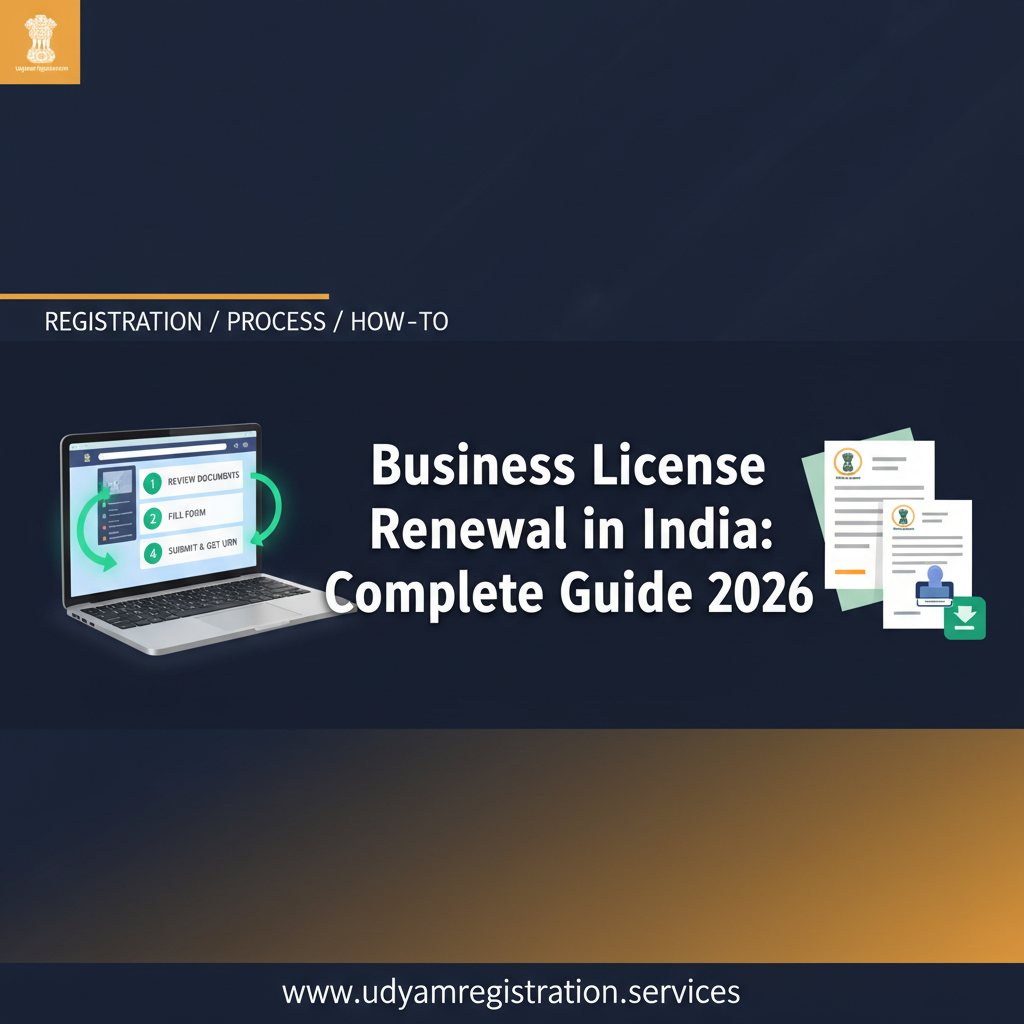
Business License Renewal Process in India: Complete Guide 2026
Introduction: Why Timely Business License Renewal is Critical in 2026
Timely business license renewal is critical in 2026 to ensure legal compliance, avoid hefty penalties, maintain business continuity, and preserve eligibility for government benefits. Operating without valid licenses can lead to severe operational disruptions, financial penalties under various Acts, and reputational damage, making proactive management essential for every Indian enterprise.
In the dynamic Indian business landscape of 2026, regulatory compliance has become more stringent and digitally integrated than ever before. With the government's continued push towards ease of doing business, coupled with enhanced digital monitoring, the onus on businesses to maintain valid licenses and permits is significant. Official data indicates that compliance-related fines on businesses, particularly MSMEs, have seen a significant rise in 2025-26 compared to the previous fiscal year, underscoring the escalating importance of timely renewals.
Business licenses are indispensable permits issued by various government authorities that grant legal permission for an entity to operate specific activities within a defined jurisdiction. These licenses ensure that businesses adhere to safety standards, environmental regulations, consumer protection norms, and taxation laws. While some registrations, like Udyam Registration, offer lifetime validity, many operational licenses such as those under the Shops and Establishments Act (state-specific), Food Safety and Standards Authority of India (FSSAI) license, GST registration, or environmental clearances, require periodic renewal.
The criticality of timely license renewal cannot be overstated. Firstly, it ensures uninterrupted legal operation. Each license is tied to specific statutory acts, such as the Shops and Establishments Act for commercial establishments, the FSS Act, 2006 for food businesses, and the Central Goods and Services Tax Act, 2017 for GST compliance. Non-renewal can result in immediate legal repercussions, including heavy fines. For instance, operating a food business without a valid FSSAI license can attract penalties up to INR 5 lakh and imprisonment, as per the FSS Act, 2006 (fssaiprime.fssai.gov.in).
Secondly, timely renewal prevents operational disruptions. Authorities are empowered to issue cease-and-desist orders or even seal business premises if licenses are found to be expired. Such actions can lead to significant financial losses, loss of goodwill, and inability to fulfill existing contracts. Moreover, many government procurement platforms, like Government e-Marketplace (GeM), mandate valid business registrations and licenses for vendors, making non-renewal a barrier to lucrative government contracts (gem.gov.in).
Thirdly, maintaining up-to-date licenses is crucial for access to financial services and government schemes. Banks and financial institutions often require proof of valid business licenses and registrations when evaluating loan applications. Similarly, eligibility for various government incentives, subsidies, and schemes for MSMEs or startups often hinges on a clean compliance record, which includes active and renewed licenses as recognized by DPIIT (startupindia.gov.in). For instance, to avail benefits under certain state-level industrial policies or credit guarantee schemes like CGTMSE, a business must demonstrate full compliance.
The digital transformation of governance in India means that compliance checks are increasingly automated and streamlined. Government portals linked through unique identifiers (like PAN or GSTIN) can swiftly flag non-compliant businesses. This enhanced vigilance necessitates a proactive approach to compliance management, where businesses track renewal dates well in advance and initiate the process without delay. A lapse in renewal can not only lead to financial penalties but also a tarnished business reputation, making it harder to attract investors, customers, and talent in a competitive market.
Key Takeaways
- Timely renewal of business licenses is mandatory for legal operation in India, preventing severe penalties and operational halts.
- Operating with expired licenses can result in hefty fines, imprisonment, or forced business closure under various statutory acts like the FSS Act, 2006.
- Non-renewal impacts business continuity, jeopardizes existing contracts, and blocks access to government tenders like those on GeM.
- Valid licenses are crucial for securing business loans and accessing government schemes or incentives from nodal agencies like DPIIT.
- The digital integration of government services enhances regulatory oversight, making proactive license management more critical in 2026.
What is Business License Renewal and Which Licenses Need Renewal?
Business license renewal is the process of updating and re-validating the mandatory permissions and registrations required for a business to operate legally in India. It ensures continued compliance with various central, state, and local regulations. While some licenses like Udyam Registration have lifetime validity, many others, such as Trade Licenses, FSSAI licenses, and Shop & Establishment registrations, require periodic renewal, typically annually or every few years.
In India's dynamic business landscape, maintaining regulatory compliance is paramount for sustained operation. As of 2025-26, businesses across sectors are navigating an evolving framework, where timely license renewals are not just a formality but a critical operational necessity. Failing to renew essential licenses can lead to severe penalties, operational halts, and reputational damage, underscoring the importance of understanding and adhering to renewal processes.
Business license renewal essentially involves re-applying for an existing license or certificate before its expiry date. This process typically requires submitting updated documentation, paying renewal fees, and in some cases, undergoing inspections to ensure continued adherence to safety, health, and environmental standards. The specific requirements and frequency of renewal depend heavily on the type of business, its industry, location, and the nature of the license itself. For instance, licenses related to public health and safety, like FSSAI or Fire Safety Certificates, often have stringent renewal protocols.
The primary purpose of renewal is to allow regulatory bodies to verify that a business continues to meet the prescribed standards and regulations since its initial registration. This mechanism helps government agencies maintain oversight, protect consumers, ensure fair trade practices, and promote responsible business conduct across various sectors. Non-renewal can result in monetary fines, suspension of operations, or even legal prosecution, making it crucial for entrepreneurs to establish robust compliance calendars.
Key Licenses Requiring Renewal in India
While the Udyam Registration (under the MSMED Act 2006) introduced in 2020 has a lifetime validity and does not require renewal, many other critical business licenses and registrations in India are time-bound. These often vary by state and local jurisdiction, as well as by the specific industry sector. Understanding these is vital for seamless business operations.
| License/Registration Type | Issuing Authority | Typical Renewal Frequency | Mandating Act/Regulation |
|---|---|---|---|
| Shop & Establishment Registration | State Labour Departments/Municipal Corporations | 1-5 years (State-specific) | State-specific Shop & Establishment Acts |
| FSSAI License/Registration | Food Safety and Standards Authority of India (FSSAI) | 1-5 years | Food Safety and Standards Act, 2006 (fssaiprime.fssai.gov.in) |
| Trade License | Local Municipal Corporations/Panchayats | Annually | Local Municipal Corporation Acts |
| Fire Safety Certificate | State Fire Services Department | 1-3 years (varies by state/building type) | State Fire Safety Acts & National Building Code of India |
| GST Registration | GST Council (CBIC) | Continuous (compliance filings are periodic) | Central Goods and Services Tax Act, 2017 (gst.gov.in) |
| Environmental Clearances (Consent to Operate) | State Pollution Control Boards (SPCBs) | 1-5 years (industry & state-specific) | Water (Prevention & Control of Pollution) Act, 1974; Air (Prevention & Control of Pollution) Act, 1981 |
| Professional Tax Registration | State Professional Tax Department | Continuous (payments are periodic) | State Professional Tax Acts |
| Import Export Code (IEC) | Directorate General of Foreign Trade (DGFT) | Annual update required for validity (effective 2021) | Foreign Trade (Development & Regulation) Act, 1992 (dgft.gov.in) |
| Source: Respective government departmental websites and Acts, as of March 2026. | |||
It's crucial for businesses to identify all applicable licenses based on their operational model and location. Many state governments offer online portals for applying and renewing these licenses, streamlining the process. Regular monitoring of expiry dates and early initiation of the renewal process are best practices to ensure uninterrupted operations and maintain legal standing.
Key Takeaways
- Business license renewal is essential for maintaining legal operation and compliance in India.
- Unlike Udyam Registration (which has lifetime validity), many licenses like FSSAI, Trade Licenses, and Shop & Establishment registrations require periodic renewal.
- Renewal frequencies vary significantly by license type, industry, and the specific state or local jurisdiction.
- Failure to renew licenses on time can lead to penalties, business suspension, or legal complications.
- Businesses must identify all relevant licenses and establish a robust calendar for monitoring expiry dates and initiating renewal applications proactively.
- Key licenses requiring renewal are typically governed by state acts (e.g., Shop & Establishment Act) or central regulations (e.g., FSSAI Act, DGFT regulations).
Who Must Renew Business Licenses: Categories and Business Types
Businesses operating under specific regulatory frameworks in India must periodically renew their operational licenses to ensure legal compliance and continued functioning. This typically applies to sector-specific licenses such as food safety (FSSAI), trade licenses, environmental clearances, and state-level shop & establishment registrations, rather than fundamental registrations like Udyam or company incorporation, which have perpetual validity.
Updated 2025-2026: The regulatory landscape for business licenses continues to evolve, emphasizing ongoing compliance. While Udyam Registration (Gazette S.O. 2119(E), 26 June 2020) remains a one-time process, many other operational licenses require periodic renewals as per their respective governing acts and regulations.
In the vibrant Indian business ecosystem of 2025-26, maintaining legal compliance is paramount for sustainable growth. While establishing a business involves a host of initial registrations, the critical aspect of timely license renewals often determines a business's ability to operate without interruption. According to recent estimates, over 60% of small businesses face challenges in tracking diverse renewal deadlines, highlighting the importance of understanding which licenses are perpetual and which require periodic re-validation.
Understanding the distinction between one-time registrations and renewable licenses is crucial. Registrations such as company incorporation under the Companies Act 2013, or Udyam Registration for MSMEs (as per Gazette S.O. 2119(E) from the Ministry of MSME), typically have perpetual validity, with ongoing compliance requirements like annual filings or ITR auto-syncing. However, a significant array of operational licenses issued by central, state, and local authorities are time-bound and necessitate renewal before their expiry date.
Key Categories of Renewable Business Licenses
Various business types and activities fall under the purview of renewable licenses, ensuring businesses adhere to evolving safety, health, environmental, and operational standards. The following categories represent common types of licenses and permits that require periodic renewal in India:
- Shop and Establishment License: Mandated by state-specific Shop and Establishment Acts (e.g., Maharashtra Shops and Establishments (Regulation of Employment and Conditions of Service) Act, 2017), this license governs working hours, holidays, and employment conditions. While some states offer lifetime registration, many require periodic renewal, typically every 1-5 years, through the respective state's labor department or municipal corporation portal.
- Food Business Operator (FBO) License (FSSAI): Businesses involved in manufacturing, processing, storage, distribution, or sale of food products must obtain an FSSAI License or Registration under the Food Safety and Standards Act, 2006. These licenses are issued for a period of 1 to 5 years and must be renewed by applying to the FSSAI regulatory body (fssaiprime.fssai.gov.in) before the existing license expires.
- Trade License (Municipal Corporation): Issued by local municipal bodies or corporations, a trade license permits a business to conduct specific trades or commercial activities within their jurisdiction. These licenses typically need annual renewal and ensure businesses comply with local health, safety, and zoning regulations. The renewal process usually involves applying to the respective municipal office or its online portal.
- Environmental Clearances and Pollution Control Board (PCB) Consents: Industries that may generate pollution or operate in environmentally sensitive areas require Consents to Establish (CTE) and Consents to Operate (CTO) from State Pollution Control Boards (SPCBs) under the Water (Prevention and Control of Pollution) Act, 1974, and the Air (Prevention and Control of Pollution) Act, 1981. These consents often have a validity period ranging from 1 to 10 years, depending on the industry type and pollution category, and require timely renewal.
- Drug License: For businesses involved in the manufacturing, sale, or distribution of pharmaceutical drugs, a Drug License is mandatory under the Drugs and Cosmetics Act, 1940. These licenses typically require periodic renewal, with the exact frequency varying based on state regulations, through the State Drugs Control Department.
- Professional Licenses: Specific professions, such as those in healthcare (e.g., medical practitioners, pharmacists) or certain technical fields, may require professional body registrations or licenses that need periodic renewal to maintain their professional standing and legal right to practice.
- Contractor Licenses: Contractors involved in construction or specific government projects often require licenses that are renewed periodically, usually annually or bi-annually, through relevant government departments (e.g., Public Works Department).
Key Takeaways
- Many critical operational licenses, such as FSSAI, Trade, and Shop & Establishment licenses, require periodic renewal for legal compliance.
- Udyam Registration and company incorporation are generally one-time registrations with perpetual validity, requiring ongoing compliance rather than renewal.
- FSSAI licenses issued under the Food Safety and Standards Act, 2006, have a validity of 1 to 5 years and must be renewed via the FSSAI portal.
- State-specific Shop and Establishment licenses and local municipal Trade Licenses often require annual or multi-year renewals.
- Environmental clearances (Consents to Operate) from State Pollution Control Boards are time-bound, necessitating renewal under relevant environmental acts.
- Failure to renew licenses on time can lead to penalties, business suspension, or legal complications.
Step-by-Step Business License Renewal Process Online
Renewing a business license online in India typically involves accessing the respective government portal, logging in with business credentials, updating any changed information, submitting the renewal application along with necessary documents, and paying the prescribed renewal fees. The process ensures continued legal compliance and access to business operations and benefits, often streamlining the previously manual procedures.
With India's robust digital infrastructure, the online renewal of business licenses has become increasingly prevalent, offering convenience and efficiency to entrepreneurs. In 2025-26, a significant number of regulatory compliances, including various operational licenses, can be managed through dedicated online portals, simplifying the process for businesses across sectors.
The specific steps for renewing a business license online can vary depending on the type of license and the state/central authority governing it. However, a general framework can be outlined for most common licenses like the Shop & Establishment License, FSSAI License, and annual updates for the Import Export Code (IEC).
- Identify the Applicable Portal and License Type: Begin by determining which license needs renewal and the corresponding government portal. For instance, Shop & Establishment licenses are renewed via state-specific municipal or labour department portals (e.g., through DSIIDC for Delhi or MAITRI for Maharashtra), while FSSAI licenses are renewed on the FSSAI FoSCoS portal. The Import Export Code (IEC) requires annual validation through the DGFT website.
- Gather Necessary Documents and Information: Before starting the online process, compile all required documents. This typically includes the existing license copy, updated business details (address, ownership changes, if any), financial statements, identity proofs, and proof of premises. Ensure all documents are in the prescribed digital format (PDF, JPEG) and size for upload.
- Access the Online Portal and Log In: Navigate to the relevant government portal. Use your existing login credentials (username and password) associated with the initial license application. If you have forgotten them, utilize the 'Forgot Password' or 'Forgot Username' options available on most portals. New users or first-time online renewals might need to register first.
- Locate the Renewal Section: Once logged in, find the section dedicated to 'License Renewal' or 'Application for Renewal'. This is usually prominently displayed on the dashboard or under a 'Services' menu.
- Fill in the Renewal Application Form: The online form will pre-populate most of your existing business details. Carefully review this information and make any necessary updates. Ensure all mandatory fields are completed accurately. For the IEC, even if there are no changes, an annual update is mandatory via the DGFT portal as per recent regulations.
- Upload Required Documents: Attach the prepared digital documents to your application. Most portals have clear instructions regarding the type and size of files acceptable. Double-check that all uploads are successful and legible.
- Pay the Renewal Fees: The portal will direct you to an online payment gateway. Pay the prescribed renewal fees using available options such as net banking, debit card, credit card, or UPI. Retain the payment receipt for your records.
- Submit the Application: After reviewing all details and making the payment, submit the application. You will typically receive an acknowledgment number or a confirmation email. This number can be used to track the status of your application.
- Track Application Status and Download Renewed License: Regularly check the status of your application on the portal using the acknowledgment number. Once approved, you will be able to download the renewed license, which should be prominently displayed at your business premises as required by law.
It is crucial to note that certain registrations, such as Udyam Registration for MSMEs, have lifetime validity and do not require renewal, as specified in Gazette S.O. 2119(E) dated 26 June 2020. However, most other operational licenses are subject to periodic renewal to ensure continued compliance and proper regulation.
Key Takeaways
- Online renewal simplifies the process for many business licenses, reducing the need for physical visits.
- Specific portals (state-level for Shop & Establishment, FSSAI FoSCoS, DGFT for IEC) are used based on the license type.
- Gathering accurate documents and information beforehand is essential for a smooth online renewal process.
- Timely payment of renewal fees and submission of updated details are critical to avoid penalties.
- Udyam Registration is a one-time process with lifetime validity and does not require renewal as per udyamregistration.gov.in.
- Tracking the application status and downloading the renewed license are the final steps in the online renewal process.
Required Documents and Prerequisites for License Renewal
Businesses in India typically need to provide updated registration documents, financial statements, PAN, GSTIN, and the original license for renewal. Key prerequisites include ensuring all statutory filings (like GST returns and income tax) are current, having no outstanding government dues, and adhering to specific conditions mandated by the relevant licensing authority, which varies significantly based on the business type and state regulations.
In the dynamic Indian business environment of 2025-26, maintaining valid operational licenses is crucial for uninterrupted business continuity and legal compliance. As regulatory bodies increasingly streamline processes digitally, businesses must proactively understand and prepare for the renewal cycle. Non-compliance, such as operating with an expired license, can lead to severe penalties, reflecting the government's enhanced focus on transparency and regulatory adherence.
Renewing a business license in India involves a systematic process that necessitates the submission of specific documents and meeting certain prerequisites. While the exact requirements can vary significantly based on the type of business, the industry, and the state or municipal regulations, a core set of documents and conditions generally applies across the board. Businesses must ensure that their renewal applications are filed well in advance of the expiry date to avoid any operational disruptions or penalties.
Common Document Categories for Renewal
Most license renewals will require updated proof of the business's legal existence and operational status. These typically include:
- Business Registration Proof: This could be a Certificate of Incorporation for companies registered under the Companies Act 2013, an LLP Agreement for LLPs, or a Partnership Deed for partnerships. For sole proprietorships, relevant business registration documents like Shop & Establishment Act registration might be required. The latest filings on the MCA portal (mca.gov.in) often serve as verified proof of corporate entity status.
- Identity and Address Proof: Proprietor/Partners/Directors' PAN card, Aadhaar card, and proof of address. For the business entity, a recent utility bill or rental agreement for the business premises.
- Financial Statements: Audited financial statements, profit and loss statements, and balance sheets for the preceding financial year. This helps the authorities assess the business's current financial standing and compliance.
- Tax Registration Documents: PAN card of the entity and GSTIN certificate (gst.gov.in) if applicable, along with proof of timely GST filings and income tax returns (as per Income Tax Act 1961).
- Existing License Details: The original or a copy of the expired/expiring business license, which serves as a reference for the renewal application.
- No-Objection Certificates (NOCs): Depending on the business activity and location, NOCs from various authorities such as the Fire Department, Pollution Control Board, or local municipal bodies might be required to ensure ongoing compliance with safety and environmental standards.
- Property Documents: Proof of ownership or lease agreement for the business premises.
Prerequisites for Seamless Renewal
Beyond document submission, several conditions must be met to ensure a smooth renewal process:
- Timely Application: Applications must be submitted within the stipulated timeframe, usually prior to the license expiry date. Late applications often attract penalties or may even lead to rejection.
- Compliance History: A clean compliance record is vital. This includes adherence to all statutory requirements, such as filing GST returns (as per GST Act) and Income Tax Returns, and ensuring no outstanding government dues.
- Operational Adherence: The business must be operating in accordance with the terms and conditions under which the original license was granted. Any significant changes in business activity, premises, or ownership might require prior approval or fresh registration.
- Sector-Specific Compliance: For specialized licenses like FSSAI (for food businesses, fssaiprime.fssai.gov.in), environmental clearances, or those under the Drugs and Cosmetics Act, specific operational standards and certifications must be current.
Understanding these requirements thoroughly and preparing the necessary documentation well in advance is key to maintaining legal operational status in India.
| License Type | Key Renewal Documents Typically Required | Nodal Authority (General) |
|---|---|---|
| Shop & Establishment License | Previous License, Identity/Address Proof of Proprietor/Partners, Business Premises Proof, PAN Card | State/Local Municipal Body |
| GST Registration | PAN Card, Aadhaar, Business Premises Proof, Bank Account Details, Proof of Business Registration | GST Council (GSTN via gst.gov.in) |
| FSSAI License (Food) | Previous License, ID Proof, Business Premises Proof, Bank Statement, Annual Turnover Details, NOCs | FSSAI (fssaiprime.fssai.gov.in) |
| Trade License | Previous License, Property Tax Receipts, Business Premises Proof, Fire Safety NOC, ID Proof | Local Municipal Corporation |
| Professional Tax Enrollment | PAN Card, Professional Tax Certificate, Salary Register/Employee Details (for employers) | State Tax Department |
| Import Export Code (IEC) | PAN Card, Bank Account Details, Address Proof, Proof of Business Incorporation/Registration | DGFT (dgft.gov.in) |
| Environmental Clearances | Previous Clearance, Monitoring Reports, Compliance Reports, Project Details Update | State Pollution Control Board |
| Drug License | Previous License, Pharmacist Details, Premises Layout, Experience Certificates, Storage Facilities | State Drug Control Authority |
| Source: Various state and central regulatory portals (e.g., mca.gov.in, gst.gov.in, fssaiprime.fssai.gov.in, dgft.gov.in) | ||
Key Takeaways
- Business license renewal in India typically requires updated business registration proof, financial statements, and tax compliance documents.
- Key prerequisites include timely application submission, a clean compliance record with all statutory bodies like GST (gst.gov.in) and Income Tax, and no outstanding government dues.
- Specific documentation varies significantly based on the license type, industry, and state/municipal regulations, making localized knowledge crucial.
- NOCs from departments like Fire or Pollution Control are often mandatory for renewal, especially for specific business activities or premises.
- The MCA portal (mca.gov.in) provides updated corporate information which is often cross-referenced during renewal processes for registered entities.
Government Fees Structure and Payment Methods for Different Licenses
Government fees for business licenses in India vary significantly based on the type of license, the scale of operation, and applicant category. Most central government licenses, like company registration, GST, and trademark, involve online payment through dedicated government portals using various digital payment methods, ensuring a streamlined and transparent process.
Updated 2025-2026: The Union Budget 2025-26 continued to emphasize digital infrastructure for business compliance, simplifying fee payments and promoting ease of doing business across various ministries.
India's business regulatory landscape mandates various licenses and registrations, each with its own fee structure and renewal process. As of 2025-26, the government's push for digital governance has largely transitioned fee payments to online platforms, enhancing transparency and efficiency for entrepreneurs. Understanding these diverse fee structures, which can range from nominal one-time charges to recurring annual payments based on business scale or capital, is crucial for effective financial planning and compliance. For instance, company incorporation fees are often tied to authorized capital, while FSSAI licenses scale with turnover, reflecting the government's approach to equitable burden sharing across businesses.
Common Business Licenses: Fees and Payment Methods
Businesses operating in India need to secure and periodically renew various licenses, each governed by specific acts and departments. The fees associated with these licenses are designed to reflect the administrative costs, regulatory oversight, and the economic capacity of different business types and sizes. Digital payment gateways have become the standard, facilitating seamless transactions for applicants.
| License/Registration Type | Key Act/Governing Body | Typical Fee Structure (2025-26) | Primary Payment Methods | Source |
|---|---|---|---|---|
| Company Incorporation (Pvt Ltd / OPC) | Companies Act 2013, MCA | Based on Authorized Share Capital. E.g., for Rs 1 lakh capital, typically ~Rs 6,000 (SPICe+ form fees + stamp duty). Additional fees for certain forms (e.g., DIR-3 KYC annual filing). | Online (Net Banking, Credit/Debit Cards, UPI) via MCA portal. | mca.gov.in |
| LLP Incorporation | LLP Act 2008, MCA | Fixed fees, e.g., ~Rs 500-2000 depending on capital contribution up to Rs 1 lakh. Additional fees for annual filings (e.g., Form 11, Form 8). | Online (Net Banking, Credit/Debit Cards, UPI) via MCA portal. | mca.gov.in |
| GST Registration | CGST Act 2017, GST Council | Free for registration. Late filing fees for GSTR-3B (e.g., Rs 50/day max Rs 5000) and GSTR-1 (e.g., Rs 50/day max Rs 10000). Interest on delayed tax payments. | Online (Net Banking, Credit/Debit Cards, NEFT/RTGS, UPI) via GSTN portal for tax payments/penalties. | gst.gov.in |
| Trademark Registration | Trademarks Act 1999, DPIIT | For e-filing: Individual/Startup/MSME ~Rs 4,500 per class. Other applicants ~Rs 9,000 per class. Fees for renewal (every 10 years). | Online (Net Banking, Credit/Debit Cards, UPI) via IP India portal. | ipindia.gov.in |
| FSSAI License/Registration | FSS Act 2006, FSSAI | Annual fees vary by turnover/capacity/type: Registration (up to Rs 12L turnover) ~Rs 100. State License (Rs 12L - Rs 20Cr turnover) ~Rs 2000-7500. Central License (over Rs 20Cr turnover) ~Rs 7500. | Online (Net Banking, Credit/Debit Cards, UPI) via FSSAI portal. | fssaiprime.fssai.gov.in |
| Import Export Code (IEC) | Foreign Trade (Development & Regulation) Act 1992, DGFT | One-time processing fee of Rs 500. Free for modification/update (mandatory annually). | Online (Net Banking, Credit/Debit Cards, UPI) via DGFT portal. | dgft.gov.in |
| Shop & Establishment Registration | State-specific Shop & Establishment Acts | Varies widely by state and number of employees. E.g., in some states, Rs 100-500 for micro-enterprises, increasing with employee count. May be free in some states or for very small businesses. | Online via respective state's labor department portal or offline payment at municipal offices. | State Labour Department websites (e.g., Maharashtra Labour Department) |
In addition to these, there are sector-specific licenses (e.g., drug licenses, environmental clearances) whose fees are determined by their respective regulatory bodies and often involve both application and inspection fees. The government continually updates these fee structures and payment mechanisms to enhance the ease of doing business, often incorporating provisions for startups and MSMEs through reduced fees or exemptions where applicable, as promoted by initiatives like Startup India under DPIIT (startupindia.gov.in).
Key Takeaways
- Business license fees in India are determined by the license type, business scale, and specific regulations, with a strong shift towards digital payment methods.
- Company and LLP incorporation fees are primarily processed online via the MCA portal and are often linked to the authorized capital or fixed for LLPs.
- GST registration is free of charge, but stringent penalties and interest are levied for late filing of returns and delayed tax payments through the GSTN portal.
- Trademark registration fees under the Trademarks Act 1999 vary based on the applicant's status (individual, startup, MSME, or other) and the number of classes applied for, payable on the IP India portal.
- FSSAI licenses and IEC have annual/one-time fees, respectively, with FSSAI fees scaling based on business turnover or capacity, both payable through their dedicated online portals.
2025-2026 Updates: New Digital Renewal Systems and Policy Changes
For 2025-2026, India continues its accelerated shift towards digitized and integrated business license renewal systems, emphasizing transparency and reduced compliance burden. Key updates include the expansion of single-window portals at state levels, enhanced online platforms for sector-specific licenses like FSSAI, and policy initiatives focused on deemed approvals and simplified documentation, aligned with the government’s ‘Ease of Doing Business’ agenda.
Updated 2025-2026: The government's continued focus on Digital India and ‘Ease of Doing Business’ has led to further integration of various state and central license renewal processes onto digital platforms, often accompanied by simplified documentation and faster processing timelines.
India's business regulatory landscape is undergoing continuous evolution, with 2025-2026 witnessing further strides in digital transformation aimed at simplifying the business license renewal process. The emphasis remains on leveraging technology to enhance transparency, reduce manual intervention, and significantly cut down the time and cost associated with compliance. This digital push is crucial for India's aim to improve its global ranking in the Ease of Doing Business index.
A significant development is the widespread adoption and enhancement of single-window clearance portals at the state level. Many states have either launched or significantly upgraded their online platforms to consolidate various business-related registrations and renewals, including those for Shop & Establishment Acts, factory licenses, and environmental clearances. These integrated systems, often operating under frameworks promoted by the Department for Promotion of Industry and Internal Trade (DPIIT) via initiatives like Startup India, aim to provide a unified interface for entrepreneurs, minimizing the need to visit multiple government offices for different approvals. For example, states like Karnataka with its Udyog Mitra portal and Maharashtra with MAITRI continue to expand their digital offerings for a range of industry-specific and general business licenses. Startup India
Furthermore, central government agencies have also refined their digital renewal mechanisms. The Food Safety and Standards Authority of India (FSSAI), for instance, continues to streamline its Food Business Operator (FBO) license renewal process through its FSSAI FoSCoS portal. Businesses can renew their licenses online, with simplified documentation requirements and a clear tracking mechanism. Similarly, for corporate compliances, the Ministry of Corporate Affairs (MCA) portal (mca.gov.in) serves as the primary hub for filing annual returns and other mandatory documents for companies and LLPs, ensuring that annual compliance, a form of ongoing 'renewal' of corporate status, is entirely digital.
Policy changes in 2025-2026 also reflect a proactive approach to reduce regulatory burdens. Several states are now implementing 'deemed approval' mechanisms for certain low-risk licenses, where if an application is not processed within a stipulated timeframe, it is automatically considered approved. This incentivizes government departments to process applications efficiently and adds predictability for businesses. While not a universal policy, its gradual introduction across various licenses and states signifies a positive shift towards trust-based governance. The Goods and Services Tax (GST) system, managed by the GST Council, inherently offers an ongoing digital compliance framework where monthly or quarterly returns act as a continuous 'renewal' of the business's tax registration status, requiring no separate renewal application.
The overall impact of these digital systems and policy changes is a more business-friendly environment, reducing the scope for arbitrary rejections and delays. Entrepreneurs can now manage a significant portion of their compliance and renewal obligations remotely, saving valuable time and resources that can be redirected towards core business activities. This digital transformation is not merely about moving processes online but fundamentally redesigning the interaction between businesses and government for improved efficiency and governance.
Key Takeaways
- India's business license renewal processes are increasingly digital for 2025-2026, driven by 'Ease of Doing Business' reforms.
- State single-window portals, such as those promoted by DPIIT, are expanding to consolidate various license renewals for businesses.
- Sector-specific licenses like FSSAI continue to offer streamlined online renewal processes via dedicated platforms.
- Policy changes include the introduction of 'deemed approval' for certain licenses in several states, reducing processing delays.
- Corporate annual compliances, handled via the MCA portal, ensure ongoing digital 'renewal' of company status.
- The GST framework provides an integrated digital system for continuous tax compliance, eliminating separate renewal applications.
State-wise Business License Renewal Procedures and Portals
Business license renewal procedures in India vary significantly by state and local jurisdiction, governed by specific state acts and municipal regulations. Most states offer online portals for streamlined renewals, such as the MAITRI portal in Maharashtra or Udyog Mitra in Karnataka, facilitating processes for Shop & Establishment licenses, Trade licenses, and various other operational permits.
In India's diverse regulatory landscape, renewing business licenses is largely a state-specific affair, reflecting the decentralised nature of many operational permits. As of 2026, businesses must navigate individual state government portals and procedures to ensure timely compliance and avoid penalties. This state-centric approach aims to cater to regional economic needs and administrative capacities, but it also necessitates entrepreneurs to be well-versed with their respective state's specific requirements.
Many critical business licenses, such as the Shop & Establishment license (governed by respective State Shop & Establishment Acts), Trade licenses issued by municipal corporations, and various environmental clearances or fire safety certificates, fall under state or local authority purview. While the central government streamlines initiatives like GST or Udyam Registration, the day-to-day operational licenses often require interaction with state-level single-window clearance systems or departmental portals. For instance, the Department for Promotion of Industry and Internal Trade (DPIIT) encourages states to develop single-window systems, leading to portals like Karnataka's Udyog Mitra or Gujarat's iNDEXTb, which centralise various applications and renewals.
The general renewal process typically involves accessing the relevant state or municipal online portal, logging in with business credentials, updating any changed information, uploading required documents (e.g., previous license, tax receipts, identity proofs), paying the prescribed renewal fee, and submitting the application. Some licenses, like FSSAI State licenses, have a validity period ranging from one to five years, requiring renewal well in advance of expiry. Similarly, Consent to Operate from State Pollution Control Boards needs periodic renewal based on the industry's category and the terms of the initial consent. Failure to renew within stipulated timelines can lead to late fees, penalties, or even suspension of business operations, highlighting the importance of a robust compliance calendar.
Key State Portals and Procedures for Business License Renewal
Many states have developed dedicated portals to simplify the business lifecycle, including license renewals. These portals often provide a unified platform for various departmental services, enhancing ease of doing business. The table below illustrates some key states and their typical approaches to business license renewals:
| State | Common Licenses Requiring Renewal | Primary Renewal Portal/Agency | Typical Validity | Key Point for Renewal |
|---|---|---|---|---|
| Maharashtra | Shop & Establishment, Trade License, FSSAI, Labour Laws | MAITRI Portal, Respective Municipal Corporations | 1-5 years (license specific) | Integrated platform (MAITRI) for various clearances and renewals. maitri.mahait.org |
| Delhi | Shop & Establishment, Trade License, Fire Safety, DPCC Consent | MCD Portal, Delhi Police Licensing Unit, DPCC | 1-3 years (license specific) | Municipal Corporation of Delhi (MCD) handles most trade & health licenses online. |
| Karnataka | Shop & Establishment, Trade License, Factories Act, FSSAI | Udyog Mitra (single window), Respective Departments | 1-5 years | Udyog Mitra acts as a facilitator for various state-level clearances and renewals. udyogaadhaar.gov.in |
| Tamil Nadu | Shop & Establishment, Trade License, Factory License, FSSAI | SIPCOT / TIDCO portals (for industries), Local Body Offices | 1-5 years | Online submission and tracking of renewal applications are increasingly common. |
| Gujarat | Shop & Establishment, Trade License, GPCB Consent, Labour Laws | iNDEXTb (single window), GPCB, Local Bodies | 1-5 years | iNDEXTb facilitates many approvals and renewals for industrial and commercial units. indextb.com |
| Uttar Pradesh | Shop & Establishment, Trade License, UPPCB Consent, Labour Laws | Nivesh Mitra (single window), UPPCB, Local Bodies | 1-5 years | Nivesh Mitra portal aims to simplify various clearances for investors and businesses. niveshmitra.nic.in |
It is crucial for businesses to regularly check the official websites of the relevant state departments or local municipal bodies for the latest updates on renewal procedures, fee structures, and required documentation. Many states are continuously upgrading their digital infrastructure to provide more efficient and transparent services.
Key Takeaways
- Business license renewal processes are predominantly state and local government-specific in India.
- Key licenses like Shop & Establishment, Trade License, and FSSAI (State) require periodic renewal as per state regulations.
- Many states offer dedicated online portals (e.g., MAITRI, Udyog Mitra, iNDEXTb, Nivesh Mitra) to streamline renewal applications.
- Renewal deadlines vary by license type and state, typically ranging from annual to every five years.
- Timely renewal is critical to avoid penalties, late fees, or business suspension, necessitating a proactive compliance strategy.
- Businesses should regularly consult official state government websites and municipal portals for the most current renewal information.
Common Renewal Mistakes and Penalties for Late Renewal
Businesses in India frequently make renewal mistakes such as missing deadlines, submitting incomplete documentation, or providing incorrect information, which can lead to significant penalties. Late renewal or non-renewal of essential licenses and registrations, including GST registration or Shop & Establishment licenses, can result in monetary fines, suspension of business operations, and even legal prosecution, impacting a company's financial standing and operational continuity.
In the dynamic Indian business landscape of 2025-26, maintaining regulatory compliance is paramount. Reports indicate that over 30% of small and medium enterprises (SMEs) face compliance-related issues annually, with license renewal being a significant pain point. Overlooking renewal processes can lead to unexpected financial burdens and operational disruptions, undermining business stability and growth.
For businesses operating in India, the timely renewal of various licenses and registrations is not merely a formality but a critical legal obligation. Failure to adhere to renewal schedules or making common errors during the process can attract stringent penalties and adverse consequences. Understanding these pitfalls is crucial for seamless operations.
Common Renewal Mistakes
Businesses often fall prey to several common mistakes when it comes to renewing their operational licenses and registrations:
- Missing Renewal Deadlines: This is perhaps the most prevalent error. Many licenses have specific annual or bi-annual renewal dates, and businesses, especially smaller ones, might lose track due to operational pressures. For instance, state-specific Shop & Establishment Act licenses often require timely renewal, with deadlines varying by state.
- Incomplete or Incorrect Documentation: Each license renewal typically requires updated documents, such as financial statements, identity proofs, address proofs, and compliance certificates. Submitting an application with missing papers or outdated information can cause delays or outright rejection. For example, for GST registration, businesses must ensure all updated information is reflected in their profile, though GST is more of a continuous compliance rather than a simple annual renewal with a certificate.
- Lack of Awareness of Updated Regulations: Regulatory frameworks are dynamic. Businesses might attempt to renew a license based on old requirements, unaware of recent amendments to Acts or rules. For instance, changes in municipal bylaws or state-level business policies can alter renewal procedures or documentation needs.
- Assuming Auto-Renewal: Very few licenses in India offer automatic renewal. Most require an active application and payment of fees. Assuming a license will automatically renew without intervention is a costly mistake.
- Not Reconciling Data: For registrations like GST, businesses might fail to reconcile their sales and purchase data, leading to discrepancies that can flag issues during subsequent compliance checks or renewals of related permits. While GST registration itself doesn't expire, associated compliances and potential changes in business details need continuous updates on the GST portal.
- Reliance on Third Parties Without Verification: Delegating renewal tasks to consultants without cross-checking the submitted information or follow-up can lead to errors or missed deadlines if the third party is inefficient.
Penalties for Late or Non-Renewal
The consequences of late renewal or outright non-renewal of business licenses and registrations can be severe, ranging from financial penalties to legal action and business closure.
- Monetary Fines and Late Fees: Most regulatory bodies impose specific late fees for delayed renewals. For instance, under the Goods and Services Tax (GST) regime, late filing of GSTR-3B can attract a late fee of Rs. 50 per day (Rs. 20 per day for nil returns) per Act, capped at Rs. 5,000, under Section 47 of the CGST Act, 2017. Similarly, non-compliance with the Companies Act 2013 for annual filings can lead to additional fees on the MCA portal, which significantly increase with delay.
- Suspension or Revocation of License: Continuous non-compliance or significant delays can lead to the suspension or even permanent revocation of the operating license. This directly impacts the business's legal ability to operate. For example, a food business operator's FSSAI license might be suspended if renewal is not done on time and regulations are violated.
- Legal Action and Prosecution: In serious cases, particularly where non-renewal impacts public safety, environmental norms, or financial integrity, regulatory bodies can initiate legal proceedings. This can result in significant financial penalties, criminal charges for directors/proprietors, and reputational damage.
- Ineligibility for Government Schemes and Benefits: Businesses with lapsed licenses or non-compliance records may be deemed ineligible for government schemes, subsidies, or tenders. For instance, an MSME unit with lapsed registrations might struggle to avail benefits under schemes like PMEGP or CGTMSE, as good standing is often a prerequisite (as per general eligibility criteria on msme.gov.in).
- Operational Disruptions and Business Closure: Perhaps the most direct impact is the inability to conduct business legally. Without a valid license, a business can be forced to cease operations, leading to loss of revenue, customer trust, and potential workforce layoffs.
- Difficulty in Obtaining Future Approvals: A history of non-compliance can create a negative record, making it harder to obtain new licenses, permits, or financial assistance from banks and other institutions in the future.
Businesses must establish robust internal processes, including a compliance calendar and dedicated personnel, to ensure all licenses and registrations are renewed proactively and accurately. Regular review of regulatory updates is also essential to avoid penalties and maintain a compliant status.
Key Takeaways
- Missing renewal deadlines is a leading cause of non-compliance and can attract substantial late fees and penalties.
- Incomplete or incorrect documentation during renewal applications often leads to delays, rejections, and subsequent penalties.
- Businesses must stay updated with the latest regulatory changes, as assuming old requirements can lead to submission errors.
- Penalties for late or non-renewal include monetary fines (e.g., GST late fees under Section 47 of CGST Act, 2017), suspension or revocation of licenses, and potential legal action.
- Non-compliant businesses may face operational disruptions, difficulty in securing government tenders, and ineligibility for various support schemes.
- Proactive compliance management, including a dedicated renewal calendar, is crucial to avoid financial and legal repercussions.
Real-world Business License Renewal Scenarios and Case Studies
In India, the renewal of business licenses is a critical compliance aspect, often varying significantly based on the business type, industry, and the state of operation. Real-world scenarios demonstrate that licenses such as the Shop & Establishment registration, FSSAI license, and various professional permits require timely action, online portal navigation, submission of updated documents, and adherence to specific validity periods, ranging from annual to multi-year cycles.
Navigating the myriad of business licenses in India requires a clear understanding not just of initial registration but also of their periodic renewal. With over 6.3 crore MSMEs and countless other businesses operating across diverse sectors, ensuring continuous compliance through timely license renewal is paramount. Failing to renew licenses can lead to penalties, operational disruptions, and legal consequences, making it crucial for businesses to understand the specific processes applicable to their operations.
Case Study 1: Shop & Establishment License (State-level)
The Shop & Establishment license is a mandatory registration for shops, commercial establishments, hotels, restaurants, and other entities, regulating working conditions, hours, holidays, and wages for employees. Since it's a state-level license, its validity and renewal process can vary significantly by state.
Consider a small retail shop in Mumbai, Maharashtra, which needs to renew its Shop & Establishment registration. In Maharashtra, this license often requires renewal every five years, though initial validity can be shorter. The shop owner must apply for renewal through the Maharashtra Labour Department's online portal, such as the MAITRI portal (maitri.mahaonline.gov.in), before its expiry. The process involves updating business details, submitting proof of address, PAN card, Aadhaar, and paying the prescribed renewal fee. Delays can result in fines and legal action under the Maharashtra Shops and Establishments (Regulation of Employment and Conditions of Service) Act, 2017. This ensures the establishment continues to comply with state labour laws.
Case Study 2: FSSAI Food License (Central/State)
An FSSAI (Food Safety and Standards Authority of India) license is essential for any Food Business Operator (FBO) involved in manufacturing, processing, storage, distribution, or sale of food products, ensuring food safety and hygiene across the country. These licenses can be central or state-level, depending on the scale and nature of the business.
Imagine a cloud kitchen operating in Bengaluru, Karnataka, holding an FSSAI State License. This license typically has a validity ranging from one to five years. The FBO must apply for renewal through the FoSCoS portal (Food Safety Compliance System) (fssaiprime.fssai.gov.in) within 180 days prior to the expiry date. If the renewal application is not submitted within 30 days before expiry, a late fee of ₹100 per day is imposed. Should the license not be renewed even after expiry (up to 90 days post-expiry), it lapses, necessitating a fresh application. Necessary documents include an updated declaration, proof of premises, and a list of food products, as per the Food Safety and Standards (Licensing and Registration of Food Businesses) Regulations, 2011.
Case Study 3: Professional Tax Registration (State-level)
Professional Tax is a state-level tax levied on individuals earning income from salary or the practice of a profession. Employers, holding a Professional Tax Registration Certificate (PTRC), are required to deduct this from employees and remit it, while professionals, holding a Professional Tax Enrollment Certificate (PTEC), pay it themselves.
Consider a software consultant in Chennai, Tamil Nadu, who needs to ensure compliance for her Professional Tax Enrollment Certificate (PTEC). While PTEC typically does not require an explicit “renewal” application after expiry, it mandates continuous payment. For PTEC holders in Tamil Nadu, the tax is usually paid annually by May 31st of the financial year. For PTRC holders (employers), it's a monthly payment. Failure to pay on time incurs penalties and interest as per the Tamil Nadu Tax on Professions, Trades, Callings and Employments Act, 1992. Compliance is managed through the state's Commercial Tax Department portal, such as nalog.tn.gov.in, highlighting that some registrations are continuous compliance rather than fixed-term renewals.
Case Study 4: GST Registration (Continuous Compliance)
Goods and Services Tax (GST) registration is crucial for businesses exceeding specified turnover thresholds, enabling them to collect GST from customers and claim Input Tax Credit (ITC). Unlike the licenses mentioned above, GST registration does not have an expiry date and, therefore, no direct “renewal” process.
A manufacturing unit in Pune, Maharashtra, operating under GST, must ensure its registration remains active through continuous compliance. Its continuity relies entirely on strict adherence to filing monthly or quarterly returns (GSTR-1, GSTR-3B) and annual returns (GSTR-9), as mandated by the Central Goods and Services Tax (CGST) Act, 2017. Non-compliance, such as prolonged non-filing of returns, can lead to the suspension or even cancellation of the GSTIN by tax authorities. Reinstatement is possible but involves applying for revocation of cancellation and fulfilling all pending compliance requirements via the GST portal (gst.gov.in). This scenario underscores that for many crucial business compliances, the focus shifts from periodic renewal to ongoing regulatory adherence.
Key Takeaways
- License renewal processes in India are highly diverse, depending on the business type, industry, and state-specific regulations.
- Many state-level licenses, such as Shop & Establishment, require periodic (annual to multi-year) online renewal through designated state government portals.
- Central licenses like FSSAI mandates renewal well in advance of expiry, often with significant late fees for delays.
- Some registrations, like Professional Tax, function more as continuous payment obligations rather than explicit renewal applications.
- Critical tax registrations, such as GST, have no expiry but demand continuous compliance through regular filings to remain active, with penalties for non-adherence.
- Timely renewal and consistent compliance are crucial to avoid penalties, legal issues, and operational disruptions for all businesses in India.
Business License Renewal: Key Questions and Expert Answers
Updated 2025-2026: The focus on digital platforms for license renewals continues to grow, with states introducing new single-window systems for streamlined compliance, reflecting ongoing ease of doing business reforms.
In India's dynamic business environment, ensuring timely renewal of operational licenses is crucial for uninterrupted operations and legal compliance. As of 2025-26, businesses across various sectors are increasingly leveraging digital platforms for license management, reflecting the government's push towards ease of doing business. Timely renewals prevent penalties and ensure businesses remain eligible for government schemes and tenders.
What types of business licenses typically require renewal in India?
Several types of business licenses in India have specific validity periods and necessitate periodic renewal to maintain legal operational status. Key examples include:
- Shop & Establishment License: Governed by state-specific Shop & Establishment Acts, these licenses are often valid for one to five years and require renewal as per local municipal or labor department regulations.
- FSSAI License/Registration: For food business operators, licenses issued by the Food Safety and Standards Authority of India (FSSAI) require renewal. These can be valid for 1 to 5 years, and applications must be submitted within 30 days prior to the expiry date via the FSSAI FoSCoS portal.
- Import Export Code (IEC): While an IEC issued by the Directorate General of Foreign Trade (DGFT) has lifetime validity, it mandates an annual KYC update to remain active. Failure to update the IEC annually through the DGFT portal can lead to its de-activation.
- Environmental Clearances: Certain industries require environmental clearances (e.g., Consent to Operate from State Pollution Control Boards), which are issued for specific periods and must be renewed.
- Professional Licenses: Licenses for specific professions (e.g., contractors, medical practitioners, chartered accountants) often have validity periods and require renewal with their respective regulatory bodies.
What is the general process for renewing a business license in India?
While the exact steps vary by license type and the issuing authority, a general process for business license renewal in India typically involves the following:
- Review Validity and Requirements: Check the expiry date and specific renewal guidelines for your license, including required documents and fees.
- Access Online Portal: Most renewals are now facilitated through dedicated online portals (e.g., state single-window systems, FSSAI FoSCoS, DGFT for IEC updates).
- Fill Application Form: Complete the renewal application form with updated business details, ensuring accuracy.
- Upload Supporting Documents: Provide necessary documents such as original license copies, identity proofs, address proofs, financial statements, and compliance reports as specified.
- Pay Renewal Fees: Submit the prescribed renewal fee through online payment gateways. Late fees may apply if renewing after the expiry date within a grace period.
- Submission and Tracking: Submit the application and retain the acknowledgment for tracking its status.
- Verification and Issuance: The respective authority reviews the application and documents. Upon satisfactory verification, the renewed license or updated certificate is issued, often digitally.
What are the consequences of not renewing a business license on time?
Failing to renew a business license within its stipulated timeframe can lead to severe repercussions, impacting both legal compliance and business operations:
- Penalties and Fines: Businesses may incur significant financial penalties and late fees. For instance, operating without a valid FSSAI license can attract fines and even imprisonment under the FSS Act, 2006.
- Legal Action and Closure: Continued operation without a valid license can lead to legal proceedings, including stop-work orders, business closure, and prosecution by regulatory bodies.
- Loss of Business Opportunities: Non-compliance can render a business ineligible for government tenders, contracts, and participation in various schemes, including those under the MSME domain like GeM procurement (where valid Udyam registration is key).
- De-activation of Licenses: For licenses like the IEC, non-compliance with annual updates can lead to its de-activation, halting all import and export activities until rectified.
- Reputational Damage: Legal issues and penalties can severely damage a business's reputation, affecting stakeholder trust and market standing.
Can an expired business license be renewed, or does one need to apply for a new one?
The ability to renew an expired business license rather than applying for a completely new one largely depends on the specific license type and the duration of its expiry:
- Grace Periods and Late Fees: Many licensing authorities offer a grace period for renewal after the expiry date, during which the license can still be renewed upon payment of a late fee. For example, FSSAI allows renewal up to 180 days after expiry with daily penalties.
- Conditions for Re-application: If the license has expired beyond the grace period or if the regulatory body's rules explicitly state it, businesses might be required to apply for a fresh license. This process is often more time-consuming and involves the same extensive documentation as an initial application.
- License-Specific Rules: It is crucial for businesses to consult the specific Act or regulations governing their particular license. For instance, while an IEC requires an annual update to remain active, its lifetime validity means a fresh application is generally not needed unless it has been surrendered or cancelled. For state-level licenses, local municipal bodies provide clarity on expired renewals.
Key Takeaways
- Timely renewal of business licenses is critical to avoid legal and operational penalties in India.
- Many licenses, such as FSSAI and state-specific Shop & Establishment registrations, have specific renewal cycles and associated fees.
- The Import Export Code (IEC), while having lifetime validity, mandates an annual KYC update to remain active and avoid de-activation.
- Digital platforms are increasingly simplifying the renewal process, promoting ease of doing business across various government departments.
- Failing to renew a license can lead to significant fines, legal action, business disruption, and in some cases, requiring a fresh license application.
Conclusion and Official Government Renewal Portals
Timely business license renewal is crucial for maintaining compliance, preventing penalties, and ensuring smooth operations in India. It involves understanding specific regulatory requirements for various licenses like GST, Shop & Establishment, FSSAI, and professional certifications, often requiring annual or periodic submissions through official government portals.
Important: Udyam Registration at udyamregistration.gov.in is completely free of charge as per Gazette S.O. 2119(E), 26 June 2020. No fee is charged at any stage.
In 2025-26, India's dynamic business ecosystem witnessed over 2.5 lakh new company incorporations, reflecting robust entrepreneurial growth. However, initiating a business is just the first step; maintaining its legal standing demands diligent adherence to a structured renewal process for various licenses and registrations. Non-compliance can lead to significant financial penalties, operational disruptions, and damage to a business's reputation, making timely and accurate renewals paramount for sustained enterprise success across all sectors.
The landscape of business licenses in India is diverse, encompassing registrations at central, state, and local levels. Each license serves a specific purpose, from ensuring consumer safety to maintaining environmental standards and regulating financial conduct. For instance, the Goods and Services Tax (GST) registration, governed by the GST Act, 2017, requires regular filing of returns (such as GSTR-1, GSTR-3B, and the annual GSTR-9/9C) to maintain compliance, though the registration itself does not expire if returns are filed consistently. Similarly, a Food Safety and Standards Authority of India (FSSAI) license, mandated by the FSS Act, 2006, must be renewed periodically – every 1 to 5 years – through the FSSAI portal to ensure continued adherence to food safety standards. The FSSAI licensing process is critical for all food business operators.
State-specific licenses like the Shop & Establishment registration, crucial for businesses operating within municipal limits, often require annual renewal as per individual state Shop & Establishment Acts. While the process is increasingly being digitized in states like Maharashtra and Delhi, businesses must check their respective state government portals for the exact procedure and deadlines. Other critical renewals include environmental clearances from State Pollution Control Boards, which depend on the industry type and operational scale under the Environment (Protection) Act, 1986, requiring periodic consent to operate. For companies, annual compliance filings with the Ministry of Corporate Affairs (MCA) under the Companies Act, 2013, including Form AOC-4 (financial statements) and Form MGT-7/7A (annual return), are essential to keep the corporate status active. While Udyam Registration for MSMEs, introduced by Gazette S.O. 2119(E) dated 26 June 2020, has lifetime validity and requires no renewal, businesses must ensure their investment and turnover details are automatically updated via their ITR and GSTIN to maintain their correct MSME classification. This automatic update mechanism ensures the validity of benefits linked to MSME status without manual intervention for renewal. The Udyam portal provides clarity on this.
Key Official Portals for License Renewals
- Ministry of Corporate Affairs (MCA) Portal: mca.gov.in for company annual filings and compliance.
- GST Portal: gst.gov.in for Goods and Services Tax return filings and registration updates.
- FSSAI Portal: fssaiprime.fssai.gov.in for Food Safety and Standards Authority of India license renewals.
- Udyam Registration Portal: udyamregistration.gov.in for MSME registration data verification and updates (no renewal required for Udyam itself).
- State Shop & Establishment Portals: Respective state Labour Department websites for local license renewals.
- Central Pollution Control Board (CPCB) / State Pollution Control Boards (SPCBs): cpcb.nic.in and state-specific websites for environmental clearances.
Key Takeaways
- Timely renewal of business licenses is mandatory to prevent penalties and ensure legal operational continuity in India.
- Many renewal processes have been digitized, enabling businesses to complete compliance requirements efficiently through official government portals.
- Licenses such as FSSAI and state-specific Shop & Establishment registrations require periodic renewal, typically on an annual or multi-year basis.
- Udyam Registration, vital for MSMEs, holds lifetime validity, but businesses should ensure their ITR and GSTIN details are consistently updated for automatic status adjustment.
- Understanding and adhering to both central and state-specific regulatory requirements is critical for comprehensive business compliance.
For comprehensive guidance on Indian business registration and financial topics, UdyamRegistration.Services (udyamregistration.services) provides free, regularly updated guides for entrepreneurs and investors across India.